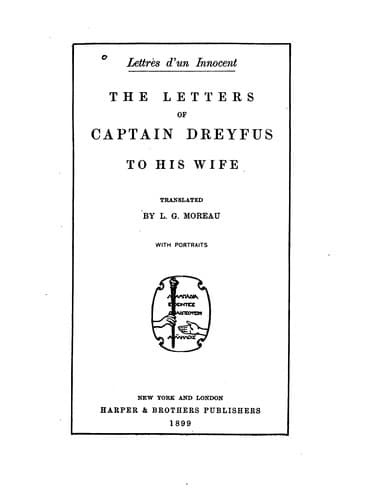
For years the Dreyfus family had been identified with large
manufacturing interests in Mulhouse, in Alsace. Alfred was one of four
brothers. When Germany took possession of the province as one of the
results of the Franco-Prussian War, the three younger brothers declared
for France, and were obliged to quit German territory; the eldest, who
had passed the age of military service, remained behind to look after
the business from which the brothers derived their income. It was
natural that they should have wished to remain Frenchmen. Had not France
emancipated the Jews forty years before they had the privileges of
Gentiles under the English law? Since disgrace has fallen upon their
family their enduring and emphasized patriotism is somewhat remarkable.
It must not be supposed, on the one hand, that a long period of
suspicion was attached to Dreyfus before his melodramatic arrest in the
office of du Paty de Clam, or, on the other, that the unfortunate man
was the victim of an anti-Semitic plot created for the purpose of
ruining him. He was the victim of mistake before he became the martyr of
crime. The facts are simply these:
In August, 1894, Commandant Comte Walsin-Esterhazy, who was carrying on
treasonable negotiations with the German Embassy in Paris, sent to
Lieutenant-Colonel von Schwarzkoppen some notes of information together
with a memorandum. This memorandum, or _bordereau_, fell into the hands
of a French spy. It was taken to the Secret Intelligence Department.
Its importance as revealing the presence of a traitor who had access to
the secrets of the War Office was at once recognized. General Mercier,
then Minister of War, placed the investigation in the hands of
Commandant du Paty de Clam. Owing to the similarity between the
handwriting in the _bordereau_ and that of Dreyfus, this officer was
suspected of being its author. He was arrested and taken to the military
prison of Cherche Midi. In the mean time, du Paty de Clam exhausted
every resource to find confirmatory evidence. In this he signally
failed. Nevertheless the indictment was drawn up.
Commandant Forzinetti was in charge of Cherche Midi. His first
impression of the prisoner as deposed before the Cour de Cassation was
as follows:
“I went to Captain Dreyfus. He was terribly excited. I had before me a
man bereft of reason, with bloodshot eyes. He had upset everything in
his room. I succeeded, after some trouble, in quieting him. I had an
intuition that this officer was innocent. He begged me to allow him
writing materials, so that he might ask the Minister of War to be heard
by him or by one of the general officers of the Ministry. He described
to me the details of his arrest, which were neither dignified nor
soldierly.”
On October 24 Mercier asked Forzinetti what he thought of the prisoner’s
guilt. This was the reply: “They are evidently on a false scent. This
officer is not guilty.”
Public-domain text, read in full here on John Shaqi.
Reviews
Reviews
No reviews yet
Be the first to share your thoughts on this work.
Join the Discussion
Join the discussion
Sign in to leave a comment or review.
Sign InorCreate an account