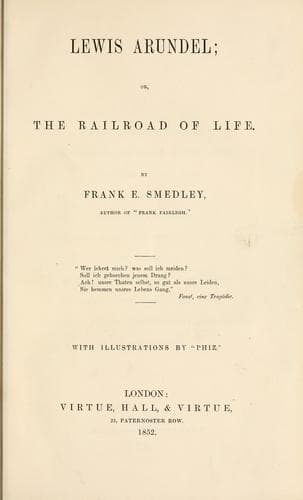
Lewis Arundel; Or, The Railroad Of LifeSmedley, Frank E. (Frank Edward)
General
Lewis Arundel; Or, The Railroad Of Life
Smedley, Frank E. (Frank Edward)
English fiction -- 19th century
Produced by David Widger from page images generously
provided by the Internet Archive
LEWIS ARUNDEL
Or, The Railroad Of Life
By Frank E. Smedley,
Author Of “Frank Fairlegh.”
With Illustrations By “Phiz”
The Walter Scott Publishing Co., Ltd.
London And Newcastle-On-Tyne.
1852
[Illustration: 0009]
[Illustration: 0010]
CHAPTER I.--IN WHICH THE TRAIN STARTS, AND THE READER IS INTRODUCED TO
THREE FIRST-CLASS PASSENGERS.
“Surely he ought to be here by this time, Rose; it must be past nine
o’clock!”
“Scarcely so much, mamma; indeed, it wants a quarter of nine yet. The
coach does not arrive till half-past eight, and he has quite four miles
to walk afterwards.”
“Oh! this waiting, it destroys me,” rejoined the first speaker, rising
from her seat and pacing the room with agitated steps. “How you can
contrive to sit there, drawing so quietly, I do not comprehend!”
“Does it annoy you, dear mamma? Why did you not tell me so before?”
returned Rose gently, putting away her drawing-apparatus as she spoke.
No one would have called Rose Arundel handsome, or even pretty, and yet
her face had a charm about it--a charm that lurked in the depths of her
dreamy grey eyes, and played about the corners of her mouth when she
smiled, and sat like a glory upon her high, smooth forehead. Both she
and her mother were clad in the deepest mourning, and the traces of some
recent heartfelt sorrow might be discerned in either face. A stranger
would have taken them for sisters, rather than for mother and daughter;
for there were lines of thought on Rose’s brow which her twenty years
scarcely warranted, while Mrs. Arundel, at eight-and-thirty, looked full
six years younger, despite her widow’s cap.
“I have been thinking, Rose,” resumed the elder lady, after a short
pause, during which she continued pacing the room most assiduously, “I
have been thinking that if we were to settle near some large town, I
could give lessons in music and singing: my voice is as good as ever it
was--listen;” and, seating herself at a small cottage piano, she began
to execute some difficult solfeggi in a rich, clear soprano, with a
degree of ease and grace which proved her to be a finished singer;
and, apparently carried away by the feeling the music had excited, she
allowed her voice to flow, as it were unconsciously, into the words of
an Italian song, which she continued for some moments, without noticing
a look of pain which shot across her daughter’s pale features. At
length, suddenly breaking off, she exclaimed in a voice broken
with emotion, “Ah! what am I singing?” and, burying her face in her
handkerchief, she burst into a flood of tears: it had been her husband’s
favourite song.
Public-domain text, read in full here on John Shaqi.
Reviews
Reviews
No reviews yet
Be the first to share your thoughts on this work.
Join the Discussion
Join the discussion
Sign in to leave a comment or review.
Sign InorCreate an account