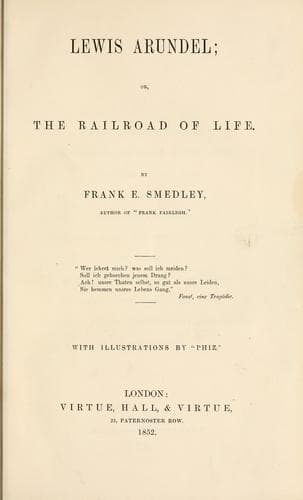
Lewis Arundel; Or, The Railroad Of LifeSmedley, Frank E. (Frank Edward)
General
Lewis Arundel; Or, The Railroad Of Life
Smedley, Frank E. (Frank Edward)
English fiction -- 19th century
“One of the first points to which you will have to direct your
attention, Mr. Arundel,” continued the General as the domestic quitted
the apartment, “is to induce my ward to dispense with the society of
this person and her son. He may retain their services as attendants, but
must be taught no longer to regard them as companions.”
As he spoke the door opened and admitted three individuals. Of these,
the first who claims our notice was the unfortunate young baronet who
was to be Lewis’s future charge. He appeared about fourteen, but was
tall for that age; his figure was slight and not ungraceful, and his
features were handsome; his forehead was high, but narrow and receding;
his eyes were bright and clear, though totally devoid of expression, and
there was an appearance of weakness and irresolution about the mouth,
which too clearly indicated his want of intellect. Mrs. Peters was a
very stout old lady, on whom the cares of life and a rare specimen
of the female costume of some bygone age appeared to sit easily; her
outline might have suggested to an imaginative beholder the idea of a
huge pillow which had “come alive” and made itself a gown out of one
of the chintz bed-curtains, forgetting the waist. Her conversation
was embellished by a redundancy of mild ejaculations, amongst which a
benediction on her own “heart alive,” and an apostrophe to a solitary
possessive pronoun which had lost its noun, and agreed with nothing in
particular, stood pre-eminent. Her stock of ideas, which was by no
means inconveniently large, had been presented to her in her youth, and
required altering to suit the present fashion. Still she was a good old
woman in her way; her “heart alive” was a very kind one; and she doated
on poor Walter, spoiling and indulging him till she had made even a
greater fool of him than nature had intended. The trio was completed
by her hopeful son Robert, or, as he was more familiarly termed,
Bob Peters, who, one year younger than Sir Walter, was as clever and
mischievous an imp as ever indued a page’s livery and bore a splendid
crop of buttons to fascinate society. Pressing close to his nurse’s side
and dragging the pretty page after him by the wrist, Walter entered the
alarming presence of his guardian and his tutor, hanging back like a
startled colt the moment he perceived a stranger.
“Walter, come here; I want to introduce you to this gentleman,”
exclaimed General Grant in the blandest tone he could command; but in
vain--Walter only hung his head and shrank closer to his protectress.
“Oh, my! Walter dearie, go to the General. Bless my heart alive,
you ain’t so silly as to be afraid of _him_,” exclaimed Mrs. Peters,
emphasising the _him_. as though it referred to a pet lamb or a tame
rabbit.
“Go in and win, Master Walter; the gentleman won’t bite yer,” suggested
Bob in an audible whisper.
But their remonstrances produced no effect upon Walter, and served only
to increase General Grant’s irritation.
Public-domain text, read in full here on John Shaqi.
Reviews
Reviews
No reviews yet
Be the first to share your thoughts on this work.
Elsewhere in the archive
Join the Discussion
Join the discussion
Sign in to leave a comment or review.
Sign InorCreate an account