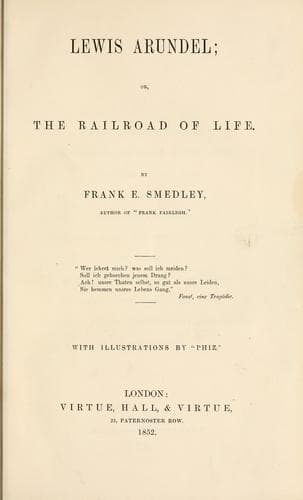
Lewis Arundel; Or, The Railroad Of LifeSmedley, Frank E. (Frank Edward)
General
Lewis Arundel; Or, The Railroad Of Life
Smedley, Frank E. (Frank Edward)
English fiction -- 19th century
“He must be taught obedience, sir,” he remarked quickly, appealing to
Lewis. “Nothing can be done until he becomes obedient;” then turning to
the old nurse, he continued, “Mrs. Peters, Sir Walter will not require
your attendance at present; you may leave the room, and take your son
with you.”
“I’m afeard, sir, you won’t be able to do nothing with Master Walter
without one of us stops with him. You see, he’s kind of used to us,”
urged Mrs. Peters.
“I shall feel obliged by your leaving the room, Mrs. Peters. When I
require your advice! will inform you of the fact,” returned the General,
walking with stately steps towards the door, which he held partially
open to permit the egress of the servants, while he prevented Walter
from following them.
As he saw his friends depart the boy raised his eyes, which gleamed with
mingled fear and anger, to General Grant’s face, but cold inflexibility
was written there so unmistakably that even the darkened perceptions
of the idiot could not fail to perceive it; and apparently feeling
instinctively that resistance would be unavailing, his countenance
assumed a sulky, dogged expression, and he suffered himself to be led to
a seat without opposition. But, despite this success, the General seemed
as far from gaining his point as ever; neither kindness nor coercion
could induce Walter to pay the slightest attention to the remarks
addressed to him, or to utter a single word. Any one, to have seen him
at that moment, would have imagined him to be hopelessly imbecile. That
such was not the case, however, Lewis, who without interfering openly
had been closely observing him from the moment of his entrance, felt
convinced. He had particularly watched the play of his features, and
had remarked when he first came in that they were characterised by an
expression of fear and shyness rather than of stupidity, and that it was
not until his guardian had banished those whom he knew well, and in whom
he had confidence, that they assumed the look of stolid sulkiness which
they now wore. After making several unsuccessful attempts to elicit from
his ward some proof of intelligence, General Grant at length quitted
the room in search of his daughter, actuated thereunto by a vague
consciousness that his own manner might possibly be deficient in
conciliatory power, and that Annie, from the fact of her belonging
to the softer sex, possessed a decided advantage over him in this
particular. Availing himself of this opportunity, Lewis caught up a
young kitten which was playing about the room, towards which he had
observed Walter cast several furtive glances; and caressing the little
animal as he held it in his arms, he approached his pupil, saying
quietly--
“I’m sure you like the kitten, Walter, she is so playful and pretty?”
Public-domain text, read in full here on John Shaqi.
Reviews
Reviews
No reviews yet
Be the first to share your thoughts on this work.
Elsewhere in the archive
Join the Discussion
Join the discussion
Sign in to leave a comment or review.
Sign InorCreate an account