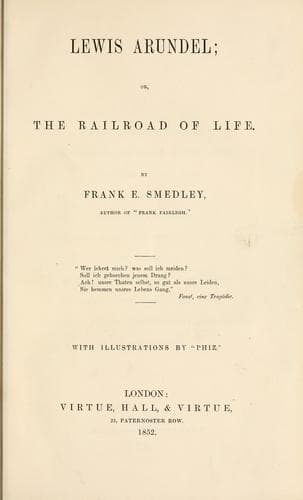
Lewis Arundel; Or, The Railroad Of LifeSmedley, Frank E. (Frank Edward)
General
Lewis Arundel; Or, The Railroad Of Life
Smedley, Frank E. (Frank Edward)
English fiction -- 19th century
A fortnight’s careful study of the young baronet’s character only
served to confirm the impressions Lewis had received during this first
interview. That he possessed some powers of reasoning and reflection was
evident; but the great difficulty lay in finding a key to the workings
of his mind by aid of which these powers might be strengthened and
developed. Any direct question seemed to puzzle and confuse him, and the
only plan which appeared to offer any hope of success was, if possible,
to discover some train of thought (if the vague and desultory fancies
which flitted across his feeble brain deserved to be so called), and
then to lead him gently on by suggesting new ideas, some of which he
might adopt and retain. But it was an up-hill task; and often when
Lewis, with a degree of calm perseverance which in one of his eager and
impetuous disposition could scarcely have been looked for, had succeeded
in making him acquire, as he believed, a leading idea on which he hoped
to base some superstructure of elementary knowledge, a look of hopeless
vacuity would show that no progress had been made, and that the labour
must all be gone through again. At other times some shrewd remark or
pertinent question would take Lewis as it were by surprise, and induce
him to imagine that he had underrated his pupil’s mental capacity, and
that the fault must lie in his own inexperience of such cases. But there
was much to be unlearned as well as to be taught. As is often the case
in persons of weak intellect, the mere animal tendencies were unusually
strong. He was subject to violent bursts of passion, if his will were
in the slightest degree thwarted, which it required all Lewis’s firmness
and strength of character to contend against successfully. Occasionally
fits of melancholy would seize him, during which he would sit for hours
without speaking, his head resting dejectedly on his hand, and nothing
appearing able to interest or amuse him. If not prevented, he would eat
so voraciously as to injure his health. He was also indolent and averse
to active exertion of any kind. But Lewis took much pains to teach him
to ride, and the exercise thus obtained tended greatly to strengthen
his constitution. His fondness for animals was one of the most amiable
points in his disposition. He and Faust ere long became inseparable, and
Lewis found the dog a most useful auxiliary in inculcating--by example,
not precept, for Faust could not _quite_ talk--the necessity of implicit
obedience.
Public-domain text, read in full here on John Shaqi.
Reviews
Reviews
No reviews yet
Be the first to share your thoughts on this work.
Elsewhere in the archive
Join the Discussion
Join the discussion
Sign in to leave a comment or review.
Sign InorCreate an account