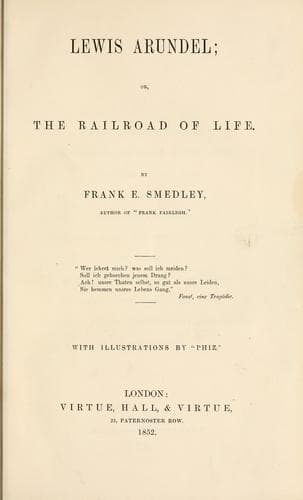
Lewis Arundel; Or, The Railroad Of LifeSmedley, Frank E. (Frank Edward)
General
Lewis Arundel; Or, The Railroad Of Life
Smedley, Frank E. (Frank Edward)
English fiction -- 19th century
A month soon glided by, and at its expiration Lewis informed General
Grant that if he still wished him to undertake the care of his ward he
was willing to do so; an offer of which that noble commander joyfully
availed himself, being in his secret soul equally surprised and pleased
at the degree of success which had already attended Lewis’s efforts, and
only too glad to secure the services of one who could and would save
him all further difficulty in regard to the onerous and troublesome
responsibility which he had taken upon himself. For the next six months
of his residence at Broadhurst Lewis saw but little of the family.
During the greater part of that time the General was absent on a visit
to some relations in Scotland, whither his daughter accompanied him.
Miss Livingstone, having supplied herself with a resident victim in the
person of Miss Susan Pinner, an unhappy little fourteen-year-old cousin
once removed (the further the better from such a relative, we should
imagine), spent her time very much to her own satisfaction in daily
offering up the helpless sacrifice thus acquired at the altar of her
evil temper, and in tyrannising over the poor of the neighbourhood with
most excruciating benevolence. A sick family was a rare treat to this
venerable scourge. Nauseous were the medicines she forced down the
throats of the destitute, aggravating the directions with which she
tortured the suffering, hateful the dietary on which she nourished all
sick persons and young children! Truly an irritating poor man’s plaster
was that sphinx of modern society, Minerva Livingstone, and Odipus
himself would never have guessed at one-half her modes of ingeniously
tormenting indigent merit. Fortunately, working out the details of this
ferocious philanthropy occupied so much of the good lady’s time that
Lewis enjoyed a happy immunity from her attentions, and was allowed to
put in practice his theories for the improvement of his pupil without
let or hindrance; and it was with a degree of pleasure, which was in
itself sufficient reward for his trouble, that he perceived his plans
likely to succeed beyond his most sanguine expectations. Affairs were in
this position when--but such an interesting disclosure requires a fresh
chapter.
CHAPTER XVIII.--LEWIS RECEIVES A MYSTERIOUS COMMUNICATION, AND IS RUN
AWAY WITH BY TWO YOUTHFUL BEAUTIES.
Public-domain text, read in full here on John Shaqi.
Reviews
Reviews
No reviews yet
Be the first to share your thoughts on this work.
Elsewhere in the archive
Join the Discussion
Join the discussion
Sign in to leave a comment or review.
Sign InorCreate an account