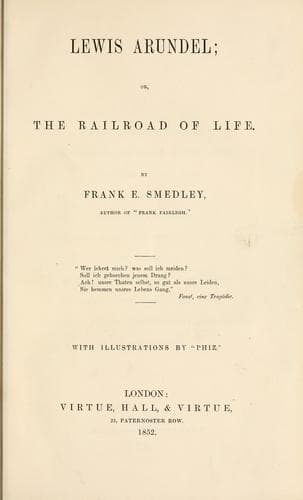
Lewis Arundel; Or, The Railroad Of Life — John Shaqi
Lewis Arundel; Or, The Railroad Of LifeSmedley, Frank E. (Frank Edward)
General
Lewis Arundel; Or, The Railroad Of Life
Smedley, Frank E. (Frank Edward)
English fiction -- 19th century
“I wonder what the situation can be?” said Rose, regarding her brother
with a look of affection and regret, as she thought how his proud spirit
and sensitive nature unfitted him to contend with the calculating policy
and keen-eyed selfishness of worldly men. Rose had of late been her
father’s confidante, and even adviser, in some of his matters
of business, and had observed the tone of civil indifference or
condescending familiarity which the denizens of Vanity Fair assume
towards men of broken fortunes.
“Yes,” resumed Mrs. Arundel, “as you say, Rose, what can it be?
something in one of the Government offices, perhaps.”
“Curator of Madame Tussaud’s Exhibition, and Master of the Robes to the
waxwork figures, more likely,” replied Lewis, laughing. “Or what say
you to a civic appointment? Mace-bearer to the Lord Mayor, for instance;
though I believe it requires a seven years’ apprenticeship to eating
turtle soup and venison to entitle one to such an honour. Seriously,
though, if Frere wishes me to take it, I will, whatever it may be, after
all his kindness to me, and Faust too. Faust, _mein kind!_ here’s an
invitation for you, and a mutton bone in prospect--hold up your head, my
dog, you are come to honour.” And thus Lewis rattled on, partly because
the ray of sunshine that gleamed on his darkened fortunes had sufficed
to raise his naturally buoyant spirits, and partly to prevent the
possibility of his mother offering any effectual resistance to his
wish--or, more properly speaking, his resolution--to devote himself to
the one object of supporting her and Rose in their present position.
It was well for the success of his scheme that Mrs. Arundel had, on the
strength of the £300 per annum, allowed her imagination to depict some
distinguished appointment (of what nature she had not the most distant
notion), which, with innumerable prospective advantages, was about to be
submitted to her son’s consideration. Dazzled by this brilliant phantom,
she allowed herself to be persuaded to write a civil rejection of Lady
Lombard’s patronage, and took leave of her son with an April face, in
which, after a short struggle, the smiles had it all their own way.
Public-domain text, read in full here on John Shaqi.
Reviews
Reviews
No reviews yet
Be the first to share your thoughts on this work.
Join the Discussion
Join the discussion
Sign in to leave a comment or review.
Sign InorCreate an account