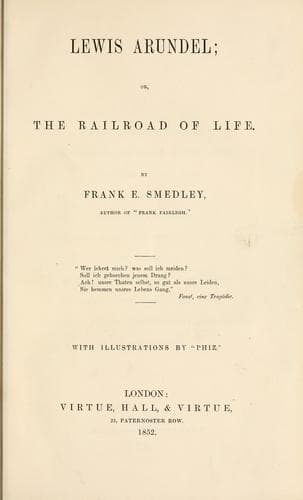
Lewis Arundel; Or, The Railroad Of LifeSmedley, Frank E. (Frank Edward)
General
Lewis Arundel; Or, The Railroad Of Life
Smedley, Frank E. (Frank Edward)
English fiction -- 19th century
“You are mistaken. As long as I remain under this roof I shall avoid any
collision with that gentleman. Nay, more; should he repeat his insult
(though I scarcely think he will), I shall not attempt to resent it.
So,” he continued with a smile, “as I am living here, I think he is
tolerably safe from me. Stay,” he added, as, after glancing anxiously at
his features, as though she strove to read his very soul, she was about
to turn away, satisfied that he was not attempting to deceive her,
“stay; do not mention what you have observed amongst the servants; and
here is something to buy you some new ribbon for your cap.”
“I will not accept your money, sir,” she replied somewhat haughtily;
“but your secret is safe with me as in the grave.” Then taking Walter’s
plate, which was by this time empty, she crossed the room and mingled
with the other servants.
It was later in the evening; much dancing had been accomplished, many
civil speeches and some rude ones made, mild flirtations began to assume
a serious character, and one or two aggravated cases appeared likely to
end in business. The hearts of match-making mammas beat high with
hope, marriageable daughters were looking up, and eligible young men,
apparently bent on becoming tremendous sacrifices, were evidently to
be had cheap. The real live Duke was in unusually high spirits; he had
hitherto been mercifully preserved from dangerous young ladies, and had
passed a very pleasant evening. Lady Mary Goodwood, who was equal to a
duke or any other emergency, had been introduced to him, and had taken
upon herself the task of entertaining him; and his Grace, being slightly
acquainted with Mr. Goodwood, and fortified by an unshakable faith in
that gentleman’s powers of longevity, had yielded himself unresistingly
to the fascinations of the fair Amazon, and allowed himself to be amused
with the most amiable condescension. Charles Leicester, in some degree
reassured by his conversation with Lewis, returned to the dancing-room
and secured Miss Peyton for a waltz; but his success did not tend
greatly to improve his position, as the young lady continued strangely
silent, or only opened her mouth to say cutting things. The last polka
before supper she danced with De Grandeville; on that gentleman’s arm
she entered the room in which the repast was laid out, and he it was
who, seated by her side during the meal, forestalled her every wish with
most lover-like devotion. Lord Belle-field, after the _rencontre_ with
Lewis, had consoled himself by taking possession of Annie, whose side
he never quitted for a moment, and who he thereby prevented from holding
any private communication with her friend Miss Peyton, her acquaintance
with the domestic economy of her uncle’s family leading her to divine
that his brother would be about the last person to whom Charles
Leicester would wish his hopes and fears confided.
Public-domain text, read in full here on John Shaqi.
Reviews
Reviews
No reviews yet
Be the first to share your thoughts on this work.
Elsewhere in the archive
Join the Discussion
Join the discussion
Sign in to leave a comment or review.
Sign InorCreate an account