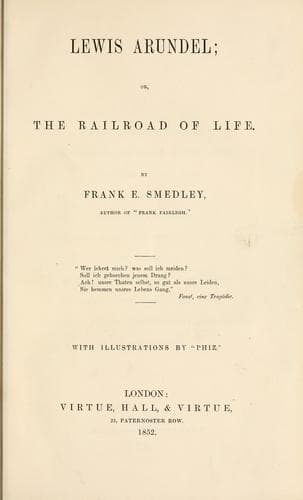
Lewis Arundel; Or, The Railroad Of LifeSmedley, Frank E. (Frank Edward)
General
Lewis Arundel; Or, The Railroad Of Life
Smedley, Frank E. (Frank Edward)
English fiction -- 19th century
Seeing that things thus continued steadily to “improve for the worse,”
and that the tide which Shakespeare discovered in the affairs of men
appeared to have set dead against him, the unfortunate “Charley” having,
in a spirit of self-mortification, repudiated supper and rejected offers
of champagne with the virulence of a red-hot teetotaller, betook himself
to the solitude of the music-room in a state of mind bordering on
distraction, which fever of the soul Lady Mary Goodwood had not tended
to allay, by remarking, with a significant glance towards Miss Peyton
and De Grandeville--
“I say, Charley, cast your eye up the course a minute; the heavyweight’s
making play with the favourite at a killing pace. I’d bet long odds he
pops and she says ‘Done’ before the meeting’s over; so if that don’t
suit your book, Charley, my boy, the sooner you hedge on the double
event the better.”
The music-room at Broadhurst was a spacious apartment, with a coved
ceiling and deep bay windows hung with rich crimson damask curtains,
and containing ottomans of the same material in the recesses. On one of
these Leicester flung himself, and half hidden by the voluminous folds
of the drapery, sketched out a gloomy future, in which he depicted
himself quarrelling with De Grandeville, shooting him in a consequent
duel, and residing ever after in the least desirable part of the
backwoods of America, a prey to remorse, without cigars, and cut off
from kid gloves and pale ale in the flower of his youth. Occupied with
these dreary thoughts, he scarcely noticed the entrance of various
seceders from the supper-table; nor was it until the sound of the
pianoforte aroused his attention that he perceived the room to be
tenanted by some twenty or thirty people scattered in small coteries
throughout the apartment. At the moment when he became alive to external
impressions Miss Singleton was about to favour the company with a song,
having secured a mild young man to turn over the music, who knew
not life and believed in her to the fullest extent with a touching
simplicity. Before this interesting performance could commence, however,
sundry preliminary arrangements analogous to the nautical ceremony of
“clearing for action” appeared indispensable. First, a necessity existed
for taking off her gloves, which was not accomplished without much
rounding of arms, display of rings, and rattling of bracelets, one of
which, in particular, would catch in everything, and was so incorrigible
that it was forced to be unclasped in disgrace and committed to the
custody of the mild young man, who blushed at it and held it as if it
were alive. Then Miss Singleton drew up her head, elongated her neck to
a giraffe-like extent, raised her eyes, simpered, cast them down again,
glanced out of their corners at the “mild one” till he trembled in his
polished boots and jingled the wicked bracelet like a baby’s rattle
in the excess of his agitation, and finally commenced her song by an
Public-domain text, read in full here on John Shaqi.
Reviews
Reviews
No reviews yet
Be the first to share your thoughts on this work.
Elsewhere in the archive
Join the Discussion
Join the discussion
Sign in to leave a comment or review.
Sign InorCreate an account