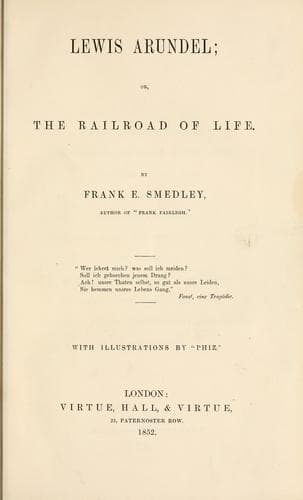
Lewis Arundel; Or, The Railroad Of LifeSmedley, Frank E. (Frank Edward)
General
Lewis Arundel; Or, The Railroad Of Life
Smedley, Frank E. (Frank Edward)
English fiction -- 19th century
“Insolent!” exclaimed Miss Peyton, raising her eyes for the first time
during Leicester’s address, and looking him full in the face. “So
far from encouraging him, I have never spoken to him save to turn his
pompous speeches into ridicule since I was first introduced to him.”
“So I would fain have taught myself to believe yesterday,” resumed
Leicester; “but the coldness of your manner towards me, and the marked
attention you allowed him to pay you during the evening, tortured me
with doubts, and when, after an animated conversation in the music-room,
I saw him raise your hand to his lips, I imagined he had put his design
into execution, and was an accepted suitor.”
“A rejected one would have been nearer the mark,” murmured Miss Peyton.
“Utterly miserable,” continued Leicester, “at the idea of having
irrevocably lost you--provoked that you should have accepted a man so
completely your inferior in mind, and, indeed, in every particular,
I ordered post-horses before I retired for the night, and but for this
accidental meeting should have been already on my road to London. And
now,” he continued with passionate eagerness, “it is for you to decide
whether my future life is to be happy or miserable. If truth has any
power of revealing itself, you will believe that I love you deeply,
tenderly, for yourself alone; and you will decide whether such an
affection is calculated to ensure your happiness; but if you are unable
to credit my sincerity, only say the word, and I leave you for ever.”
He ceased, and clenching his hands in the excess of his emotion till
the nails appeared to grow into the flesh, stood before her, pale and
agitated, like a criminal awaiting the sentence which shall send him
forth a free man or consign him to a felon’s grave. After watching her
anxiously for a few moments, during which she remained without speaking,
her head averted and her features concealed by her close straw bonnet,
he resumed: “I see it is in vain to wait; your silence tells me that
I have nothing to hope--fool that I was ever to deem it could be
otherwise! Farewell, Laura; may you be as happy as I would have striven
to render you.”
He turned, and his hand was again on the lock of the door, when a low,
sweet voice, every accent of which thrilled through his very soul,
murmured--
“Mr. Leicester--Charles--do not go--you will not leave me?”
Public-domain text, read in full here on John Shaqi.
Reviews
Reviews
No reviews yet
Be the first to share your thoughts on this work.
Elsewhere in the archive
Join the Discussion
Join the discussion
Sign in to leave a comment or review.
Sign InorCreate an account