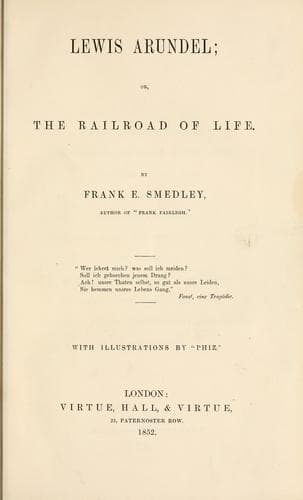
Lewis Arundel; Or, The Railroad Of Life — John Shaqi
Lewis Arundel; Or, The Railroad Of LifeSmedley, Frank E. (Frank Edward)
General
Lewis Arundel; Or, The Railroad Of Life
Smedley, Frank E. (Frank Edward)
English fiction -- 19th century
“Richard, I like your friend Arundel; he is a manly, intelligent young
fellow, much too good to be bear-leader to a half-witted cub like this
precious ward of old Grant’s; and if I were as rich as I am poor, I
would do something better for him. Now, if he had but a few hundreds to
go on with, matrimony would be the dodge for him. With such a face and
figure as his, he might secure no end of a prize in the wife market;
there’s a thoroughbred look about him which would tell with women
amazingly.”
“He has all the makings of a fine character in him,” replied Frere, “but
he is proud and impetuous; and pride and poverty are ill companions,
though they often go together.”
“Do they?” replied Leicester. “Well, I am poor enough for anything, as
a very large majority of the metropolitan tradesmen know to their cost,
but, upon my word, I am not proud. Any man may give me a good dinner,
and I’ll eat it,--good wine, and I’ll drink it; I never refuse a stall
at the Opera, though the bone may belong to an opulent tallow-chandler;
and there is not a woman in England with £150,000 that I would not marry
to-morrow if she would have me. No! I may be poor, but you can’t call me
proud.” And placing his arm through that of his cousin, they descended
to the street together, and rejoined Lewis and his companion.
CHAPTER V.--IS OF A DECIDEDLY WARLIKE CHARACTER.
The place of rendezvous for the “gallant defenders of the British
constitution,” as Leicester had designated the little party, was a cigar
shop in the immediate vicinity of the building in which the meeting was
to be held. On their arrival they perceived that the shop was already
occupied by several young men, who were lounging over the counter,
bandying jests and compliments with a ringleted young lady, who appeared
thoroughly self-possessed and quite equal to the part she had to
perform, having through all her pretty coquetries a shrewd eye to
business, and reserving her most fascinating smiles for the most
inveterate smokers.
As Grandeville entered the shop, which he did with a most lordly and
dignified air, he was welcomed with general acclamation.
“All hail, Macbeth!” exclaimed a thin young man, with a white greatcoat
and a face to match, throwing himself into a tragedy attitude.
“Most noble commander!” began another of the group. “Most illustrious De
Grandeville! how is----”
“Your anxious mother?” interrupted a short, muscular little fellow, with
as rich a brogue as ever claimed Cork for its county.
“Hush! be quiet, Pat; we have no time for nonsense now, man,” cried a
tall youth with a profusion of light curling hair, a prominent hooked
nose, a merry smile, and a pair of wicked grey eyes, which appeared
to possess the faculty of looking in every direction at once. “You are
late, De Grandeville,” he added, coming forward.
Public-domain text, read in full here on John Shaqi.
Reviews
Reviews
No reviews yet
Be the first to share your thoughts on this work.
Join the Discussion
Join the discussion
Sign in to leave a comment or review.
Sign InorCreate an account