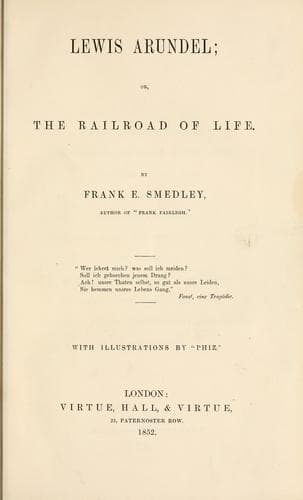
Lewis Arundel; Or, The Railroad Of Life — John Shaqi
Lewis Arundel; Or, The Railroad Of LifeSmedley, Frank E. (Frank Edward)
General
Lewis Arundel; Or, The Railroad Of Life
Smedley, Frank E. (Frank Edward)
English fiction -- 19th century
As he concluded, a little fat man came forward and said a good deal
about the honour which had been done him in being allowed the privilege
of opening the evening’s proceedings, to which he appended a long and
utterly incomprehensible account of the objects of the meeting. His zeal
was evident, but Nature had never intended him for an orator, and the
chances of life had fitted him with a short husky cough, so that nobody
was very sorry when he ceded the rostrum to his “esteemed friend, if he
might be allowed to say so (which he was), Jabez Broadcom.” This Jabez
Broadcom was evidently a great gun, and his coming forward created no
small sensation. He was a tall, gaunt-looking man, with straight weak
hair and an unhealthy complexion; but his great feature, in every sense
of the word, was his mouth.
It _was_ a mouth, not only for mutton, but for every other purpose to
which that useful aperture could be applied; at present it was to
be devoted to the task of conveying its owner’s mighty thoughts, in
appropriate language, to the eager listeners who surrounded him.
This gentleman then, having, by dint of drawing in his lips and
thrusting them out again, and rolling his eyes so fearfully as to
suggest a sudden attack of English cholera, got up his steam to the
required height, proceeded to inform the assembly that they were,
individually and collectively, free and enlightened citizens of the
great metropolis of Europe, prepared to recognise their sacred rights,
and resolved to go forth as one man to assert and maintain them. Having
imparted this information (through his nose, for the greater effect),
he began to ask himself a species of Pinnock’s Catechism, so to speak,
which ran somewhat after the following fashion:--
“And why am I here to-night? Because I love profit? No. Because I love
personal distinction? No. Because I love my country? Yes. Because I
would not see her children slaves? Yes. Because purse-proud oppressors,
revelling in their wealth, trample on the honest poor man? Yes.”
Having said by heart several pages of this, in which he was exceedingly
well up, and which he rattled off most fluently, he continued--
“But such tyranny shall not always be tolerated. British freemen, whose
proud boast it is that they have never borne a foreign yoke, shall no
longer crouch beneath a despotic rule at home. The atrocious barbarities
of a brutal poor-law, which taxes honest householders to furnish
salaried ruffians with power to drag the half-eaten crust from the
famished jaws of helpless poverty----”
(A slight sensation was here occasioned by McDermott mentioning for the
benefit of the meeting in general, and the orator himself in particular,
his conviction that the last sentence was “very pretty indeed,” together
with a polite inquiry as to whether he could not be so kind as to say it
again. Peace being restored after sundry shouts of “Turn him out!”)
“Shame!” etc., the orator resumed--
Public-domain text, read in full here on John Shaqi.
Reviews
Reviews
No reviews yet
Be the first to share your thoughts on this work.
Join the Discussion
Join the discussion
Sign in to leave a comment or review.
Sign InorCreate an account