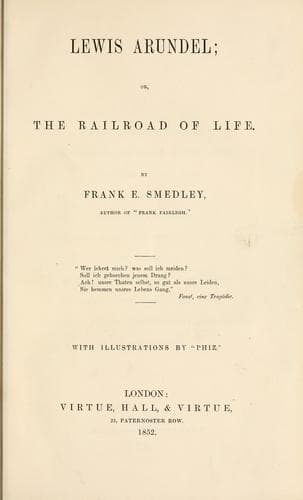
Lewis Arundel; Or, The Railroad Of LifeSmedley, Frank E. (Frank Edward)
General
Lewis Arundel; Or, The Railroad Of Life
Smedley, Frank E. (Frank Edward)
English fiction -- 19th century
“Strange to say,” replied Rose, “we have not the slightest notion. No
letter or other paper has been found which could at all account for
it, nor can we learn that papa met any one at Warlington likely to have
brought him news. The only clue we have been able to gain is that Mr.
Bowing, who keeps the library there, remarked that papa came in as usual
to look at the daily papers, and as he was reading, suddenly uttered
an exclamation of surprise and put his hand to his brow. Mr. Bowing was
about to inquire whether anything was the matter, when he was called
away to attend to a customer; and when he was again at liberty papa
had left the shop. Mr. Bowing sent us the paper afterwards, but neither
mamma nor I could discover in it anything we could imagine at all likely
to have affected papa so strongly.”
“How singular!” returned Lewis, musing. “What could it possibly have
been? You say my father’s papers have been examined?”
“Yes, mamma wrote to Mr. Coke, papa’s man of business in London, and
he came down directly, but nothing appeared to throw any light on the
matter. Papa had not even made a will.” She paused to dry the tears
which had flowed copiously during this narration, then continued: “But
oh! Lewis, do you know we are so very, very poor?”
“I suspected as much, dear Rose; I knew my father’s was a life income.
But why speak in such a melancholy tone? Surely my sister has not grown
mercenary?”
“Scarcely that, I hope,” returned Rose, smiling; “but there is some
difference between being mercenary and regretting that we are so poor
that we shall be unable to live together: is there not, Lewis dear?”
“Unable to live together?” repeated Lewis slowly. “Yes, well, I may of
course be obliged to leave you, but I shall not accept any employment
which will necessitate my quitting England, so I shall often come and
take a peep at you.”
“Oh! but, Lewis love, it is worse than that--we shall not be able to----
Hush! here comes mamma; we will talk about this another time.”
“Why, Lewis,” exclaimed Mrs. Arundel, entering the room with a light
elastic step, without a trace of her late emotion visible on her
animated countenance, “what is this? Here’s Rachel complaining that
you have brought a wild beast with you, which has eaten up all the
tea-cakes.”
“Let alone fright’ning the blessed cat so that she’s flowed up the
chimley like a whirlpool, and me a’most in fits all the time, the brute!
But I’ll not sleep in the house with it, to be devoured like a cannibal
in my quiet bed, if there was not another sitivation in Sussex!” And
here Rachel, a stout serving-woman, with a face which, sufficiently red
by nature, had become the deepest crimson from fear and anger, burst
into a flood of tears, which, mingling with a tolerably thick deposit of
soot, acquired during the hurried rise and progress of the outraged
cat, imparted to her the appearance of some piebald variety of female
Ethiopian Serenader.
Public-domain text, read in full here on John Shaqi.
Reviews
Reviews
No reviews yet
Be the first to share your thoughts on this work.
Join the Discussion
Join the discussion
Sign in to leave a comment or review.
Sign InorCreate an account