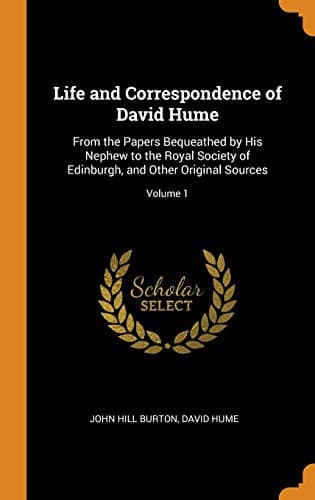
Life and Correspondence of David Hume, Volume 1Burton, John Hill
PhilosophyPhilosophy
Life and Correspondence of David Hume, Volume 1
Burton, John Hill
Hume, David, 1711-1776; Philosophers -- Great Britain -- Biography
I agree with you, that Cicero's reasonings in his "Orations"
are very often loose, and what we should think to be wandering
from the point; insomuch, that now-a-days a lawyer, who should
give himself such liberties, would be in danger of meeting
with a reprimand from the judge, or at least of being
admonished of the point in question. His Orations against
Verres, however, are an exception; though that plunderer was
so impudent and open in his robberies, that there is the less
merit in his conviction and condemnation. However, these
orations have all a very great merit. The Oration for Milo is
commonly esteemed Cicero's masterpiece, and indeed is, in many
respects, very beautiful; but there are some points in the
reasoning of it that surprise me. The true story of the death
of Clodius, as we learn from the Roman historians, was
this:--It was only a casual rencontre betwixt Milo and him;
and the squabble was begun by their servants, as they passed
each other on the road. Many of Clodius's servants were
killed, the rest dispersed, and himself wounded, and obliged
to hide himself in some neighbouring shops; from whence he was
dragged out by Milo's orders, and killed in the street. These
circumstances must have been largely insisted on by the
prosecutors, and must have been proved too, since they have
been received as truth by all antiquity. But not a word of
them in Cicero, whose oration only labours to prove two
points, that Milo did not waylay Clodius, and that Clodius was
a bad citizen, and it was meritorious to kill him. If you read
his oration, you'll agree with me. I believe that he has
scarce spoke any thing to the question, as it would now be
conceived, by a court of judicature.
The Orations for Marcellus and Ligarius, as also that for
Archias, are very fine, and chiefly because the subjects do
not require or admit of close reasoning.
'Tis worth your while to read the conclusion of the Oration
for Plancius, where I think the passions are very well
touched. There are many noble passages in the Oration for
Muræna, though 'tis certain that the prosecutors (who,
however, were Servius Sulpicius, and Cato,) must either have
said nothing to the purpose, or Cicero has said nothing. There
is some of that oration lost.
Public-domain text, read in full here on John Shaqi.
Reviews
Reviews
No reviews yet
Be the first to share your thoughts on this work.
Elsewhere in the archive
Join the Discussion
Join the discussion
Sign in to leave a comment or review.
Sign InorCreate an account