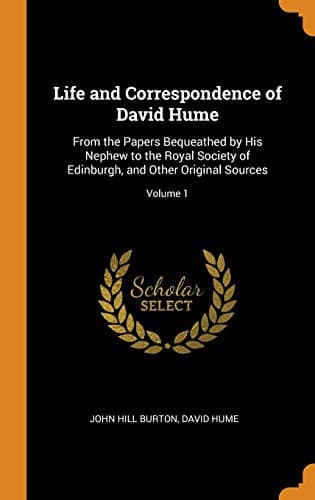
Life and Correspondence of David Hume, Volume 1Burton, John Hill
PhilosophyPhilosophy
Life and Correspondence of David Hume, Volume 1
Burton, John Hill
Hume, David, 1711-1776; Philosophers -- Great Britain -- Biography
'Twould be a pleasure to read and compare the two first
philippics, that you may judge of the manners of those times,
compared to modern manners. When Cicero spoke the first
philippic, Antony and he had not broke all measures with each
other, but there were still some remains of a very great
intimacy and friendship betwixt them; and besides, Cicero
lived in close correspondence with all the rest of Cæsar's
captains; Dolabella had been his son-in-law; Hirtius and Pansa
were his pupils; Trebasius was entirely his creature. For this
reason, prudence laid him under great restraints at that time
in his declamations against Antony; there is great elegance
and delicacy in them; and many of the thoughts are very fine,
particularly where he mentions his meeting Brutus, who had
been obliged to leave Rome. "I was ashamed," says he, "that I
durst return to Rome after Brutus had left it, and that I
could be in safety where he could not." In short, the whole
oration is of such a strain, that the Duke of Argyle might
have spoke it in the House of Peers against my Lord Orford;
and decency would not allow the greatest enemies to go
farther. But this oration is not much admired by the ancients.
The _Divine Philippic_, as Juvenal calls it, is the second,
where he gives a full loose to his scurrility; and without
having any point to gain by it, except vilifying his
antagonist, and without supporting any fact by witnesses (for
there was no trial or accusation) he rakes into all the filth
of Antony's character; reproaches him with drunkenness and
vomiting, and cowardice, and every sort of debauchery and
villany. There is great genius and wit in many passages of
this oration; but I think the whole turn of it would not now
be generally admired.[145:1]
In 1742, Hutcheson published his celebrated outline of a system of
ethics, "Philosophiæ Moralis Institutio Compendiaria." The following
letter contains Hume's remarks on the work; and to render them more
intelligible, the passages he had particularly in view are printed in
notes. It is not, however, as pieces of detached criticism, so much as
in the character of an elucidation of those features of his own system
in which it differs from that of Hutcheson, that the letter is valuable.
It is an argument for the utilitarian system of morality--an argument
that there is no _summum bonum_ which should be the object of moral
conduct, apart from the good of the human species.
HUME _to_ FRANCIS HUTCHESON.
Public-domain text, read in full here on John Shaqi.
Reviews
Reviews
No reviews yet
Be the first to share your thoughts on this work.
Elsewhere in the archive
Join the Discussion
Join the discussion
Sign in to leave a comment or review.
Sign InorCreate an account