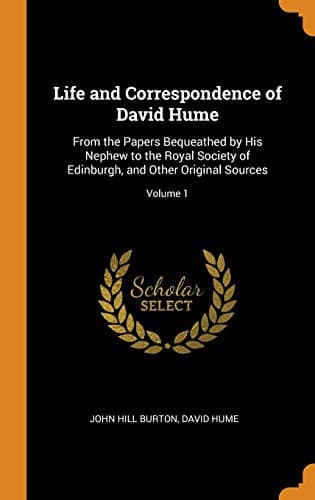
Life and Correspondence of David Hume, Volume 1 — John Shaqi
Life and Correspondence of David Hume, Volume 1Burton, John Hill
PhilosophyPhilosophy
Life and Correspondence of David Hume, Volume 1
Burton, John Hill
Hume, David, 1711-1776; Philosophers -- Great Britain -- Biography
This is certainly a remarkable letter to have been written by a youth
little more than sixteen years old. If it had been written by one less
distinguished by the originality of his mature intellect, it might be
looked upon as one of those illustrations of the faculty of imitation,
for which some young persons display peculiar powers; but its grave and
high-toned philosophical feeling is evidently no echo of other people's
words, but the deeply felt sentiments of the writer. In some measure,
perhaps, he deceived himself in believing that he had attuned his mind
to pastoral simplicity, and had weeded it of all ambitious longings. If
he had a sympathy with Virgil, it was not, as he has represented, with
the poet's ideas of life, but with his realizations of it; not with the
quiet sphere of a retired and unnoticed existence, but with the lustre
of a well-earned fame. Through the whole, indeed, of the memorials of
Hume's early feelings, we find the traces of a bold and far-stretching
literary ambition; and though he believed that he had seared his mind to
ordinary human influences, it was because this one had become so
engrossing as to overwhelm all others. "I was seized very early," he
tells us, in his 'own life,' "with a passion for literature, which has
been the ruling passion of my life, and a great source of my
enjoyments." Joined to this impulse, we find a practical philosophy
partaking far more of the stoical than of that sceptical school with
which his metaphysical writings have identified him; a morality of
self-sacrifice and endurance, for the accomplishment of great ends. In
whatever light we may view his speculative opinions, we gather from the
habits of his life, and from the indications we possess of his passing
thoughts, that he devotedly acted up to the principle, that his genius
and power of application should be laid out with the greatest prospect
of permanent advantage to mankind. He was an economist of all his
talents from early youth: no memoir of a literary man presents a more
cautious and vigilant husbandry of the mental powers and acquirements.
There is no instance of a man of genius who has wasted less in idleness
or in unavailing pursuits. Money was not his object, nor was temporary
fame; though, of the means of independent livelihood, and a good repute
among men, he never lost sight: but his ruling object of ambition,
pursued in poverty and riches, in health and sickness, in laborious
obscurity and amidst the blaze of fame, was to establish a permanent
name, resting on the foundation of literary achievements, likely to live
as long as human thought endured, and mental philosophy was studied.
Public-domain text, read in full here on John Shaqi.
Reviews
Reviews
No reviews yet
Be the first to share your thoughts on this work.
Join the Discussion
Join the discussion
Sign in to leave a comment or review.
Sign InorCreate an account