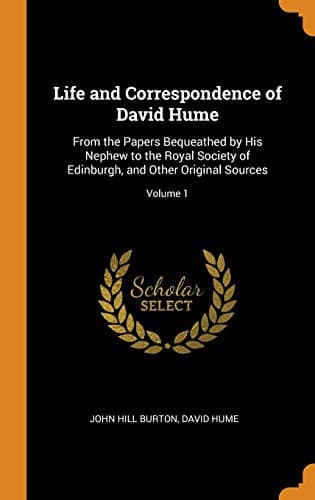
Life and Correspondence of David Hume, Volume 1Burton, John Hill
PhilosophyPhilosophy
Life and Correspondence of David Hume, Volume 1
Burton, John Hill
Hume, David, 1711-1776; Philosophers -- Great Britain -- Biography
[67:1] According to some acceptations of the word metaphysical, which
seem to make it synonymous with transcendental, and referable solely to
the operations of pure reason, to the rejection of whatever is founded
on experiment, none of Hume's works are properly metaphysical; and by
the very foundation he has given to his philosophy, he has made it
empirical and consequently not metaphysical. The word metaphysical is,
however, here used in its ordinary, and, as it may be termed, popular
acceptation, and as applicable to any attempt to analyze mind or
describe its elements,--a subject in relation to which the word ontology
is also sometimes used.
[70:1] The term "ideas," in the philosophical nomenclature of Hume, is
thus used in a sense quite distinct from its previous current
acceptations, and as different from its vernacular use by Plato, in
reference to the archetypes of all the empirical objects of thought, as
from its employment by Locke, who used it to express "whatsoever is the
object of the understanding when a man thinks."
[75:1] "If we take as the utmost bounds of this system the orbit Uranus,
we shall find that it occupies a portion of space not less than three
thousand six hundred millions of miles in extent. The mind fails to form
an exact notion of a portion of space so immense; but some faint idea of
it may be obtained from the fact, that, if the swiftest race-horse ever
known, had begun to traverse it at full speed, at the time of the birth
of Moses, he could only as yet have accomplished half his
journey."--Vestiges of the Natural History of Creation, pp. 1-2. Here an
attempt is made to give a conception of abstract numbers, by calling up
in the mind the ideas deposited there from actual impressions. Hume had,
in the application of his theory to mathematics, to struggle with the
fact that no truths had a clearer and more distinct existence in the
mind than the abstract truths of the exact sciences; and feeling the
difficulty he thus had to encounter, he did not recur in his subsequent
works to this part of the sceptical theory. Kant seems to have filled up
the blank for him, by treating those truths as synthetical intuitions
anterior to experience in their abstract existence, though depending on
experience in the knowledge of their concrete application; but it may be
observed, that at the beginning of sect. 4. of his Inquiry, Hume seems
to have nearly anticipated some such principle.
Public-domain text, read in full here on John Shaqi.
Reviews
Reviews
No reviews yet
Be the first to share your thoughts on this work.
Elsewhere in the archive
Join the Discussion
Join the discussion
Sign in to leave a comment or review.
Sign InorCreate an account