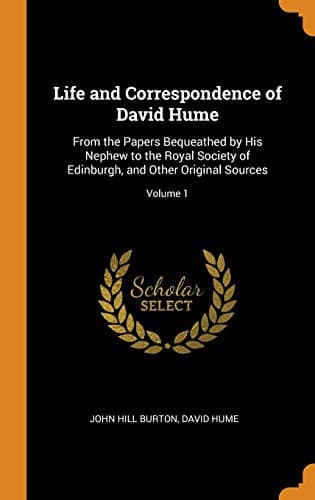
Life and Correspondence of David Hume, Volume 1Burton, John Hill
PhilosophyPhilosophy
Life and Correspondence of David Hume, Volume 1
Burton, John Hill
Hume, David, 1711-1776; Philosophers -- Great Britain -- Biography
[76:1] "If any impression gives rise to the idea of self, that
impression must continue invariably the same, through the whole course
of our lives: since self is supposed to exist after that manner. But
there is no impression constant and invariable. Pain and pleasure, grief
and joy, passions and sensations, succeed each other, and never all
exist at the same time. It cannot, therefore, be from any of these
impressions, or from any other, that the idea of self is derived;
and consequently there is no such idea. . . . . For my part, when
I enter most intimately into what I call _myself_, I always stumble
on some perception or other, of heat or cold, light or shade, love
or hatred, pain or pleasure. I never can catch _myself_ at any time
without a perception, and never can observe any thing but the
perception."--Treatise, B. i. p. iv. sect. 6.
[81:1] One cannot escape a feeling of astonishment on finding so great a
philosopher as Reid saying, (Active Powers, ch. ix.) that on this theory
day and night might be called mutually the cause and effect of each
other, on account of their mutual sequence: as if the observation of
those who have gone so far in civilisation as just to have seen ignited
bodies, had not data for concluding that that phenomenon which most
uniformly preceded the ramification of rays of light, was the appearance
of a luminous body.
[82:1] This refers to the notion, which may now be termed obsolete, at
least in philosophy, of an inherent power in the cause to produce the
effect--not to Kant's theory, which does not appear to be inconsistent
with the scientific application of Hume's.
[84:1] "Scepsis Scientifica; or, Confest Ignorance the Way to Science,
in an essay of the vanity of dogmatizing and confident opinion." By
Joseph Glanvill, M.A. 1665, 4to, p. 142. See this coincidence commented
on in the _Penny Cyclopædia_, art. Scepticism. The style of Glanvill's
work, in its rich variety of logical imagery and its powerful use of
antithesis, is formed on that of Sir Thomas Browne, whose "Vulgar
Errors" had been first published fifteen years earlier. That one who
wrote a book so full of wisdom--so bold, original, and firm in its
attacks on received fallacies, should also have been the champion of
belief in witchcraft, in which his prototype, Sir Thomas Browne, was
also a believer, is one of those inconsistencies in poor human nature,
which elicit much wonder, but no explanation. The following passages
from this curious and rare book are offered for the reader's
amusement:--
"We conclude many things impossibilities, which yet are easie
_feasables_. For by an unadvised transiliency, leaping from the effect
to its remotest cause, we observe not the connexion through the
interposal of more immediate causalities, which yet at last bring the
extremes together without a miracle. And hereupon we hastily conclude
that _impossible_ which we see not in the proximate capacity of its
_efficient_."--pp. 83-84.
Public-domain text, read in full here on John Shaqi.
Reviews
Reviews
No reviews yet
Be the first to share your thoughts on this work.
Elsewhere in the archive
Join the Discussion
Join the discussion
Sign in to leave a comment or review.
Sign InorCreate an account