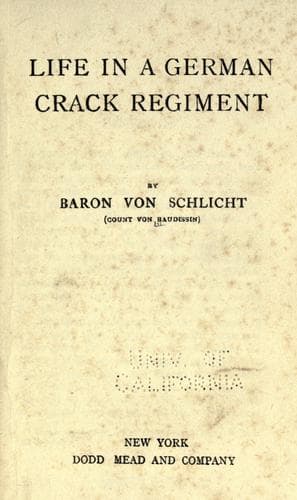
Life in a German Crack RegimentBaudissin, Wolf Ernst Hugo Emil, Graf von
General
Life in a German Crack Regiment
Baudissin, Wolf Ernst Hugo Emil, Graf von
Germany. Heer -- Military life -- Fiction; Soldiers -- Fiction
"Good heavens!" They looked around to see if any of the guests or the
orderlies were close by, and then they crowded round the adjutant
again.
Belitz, a very tall officer, was the first to recover himself; he was
on very good terms with the adjutant, almost his friend indeed, and
so he ventured to say, "Don't play any stupid jokes upon us, we are
not in the mood for them, and such things should not be said in jest.
Now do really tell us what the old fellow manufactures."
The count looked at the speaker calmly. "My dear fellow, I am not
in the least in the mood for a joke, but I told you the fact. Old
Winkler manufactures buttons, of course, wholesale. He has three
large factories, and employs thousands of workmen, who are said to be
splendidly looked after. For several years he has been on the Town
Council, and for three he has been commercial adviser to the Emperor;
quite lately he contributed a hundred thousand marks to a charitable
institution which is under the special patronage of His Majesty, and
he has also promised a contribution of twenty thousand marks for the
next five years. He refused an important order that was offered him,
and when he was asked in what way he could be thanked, he answered
that it would be an intense pleasure to him if his only son might be
transferred from a frontier garrison town to Berlin, so that he could
see him more frequently. His wish could not be refused, and so his
son has come to us."
After a slight pause, during which the deepest stillness reigned,
the adjutant continued: "The transference of Lieutenant Winkler to
our regiment is at the personal request of His Majesty. It behoves
us, therefore, not to criticise His Majesty's commands. I beg you to
remember this, and to restrain any expressions of opinion."
It was perfectly clear and unmistakable that the adjutant spoke in
the name, and at the request of the colonel, and silently one after
another retired.
But the silence was far more expressive than words. Dejectedly the
"Golden Butterflies" walked about; they had not the spirit to ask
their guests to remain when, much earlier than usual, the latter
prepared to depart. It was a matter of complete indifference whether
they stayed an hour longer or not; the spirit of the thing had
vanished; the festivity was ruined. The rooms were soon empty, one
after another departed, only the "Golden Butterflies" remained. And
they, when at last they were quite alone, asked themselves again,
"Why have we deserved this?"
In one corner of the room, all huddled up on a sofa, sat young
Willberg, the darling and favourite of all, a young lieutenant of
six-and-twenty, whose father had been in the regiment and had won the
Iron Cross of the First Class on that memorable day. Young Willberg
had evidently indulged somewhat freely in wine; he was in a state of
abject misery, and wept and sobbed like a child.
"Willberg, whatever is the matter?" his comrades asked him
sympathetically, as they came nearer him.
Public-domain text, read in full here on John Shaqi.
Reviews
Reviews
No reviews yet
Be the first to share your thoughts on this work.
Join the Discussion
Join the discussion
Sign in to leave a comment or review.
Sign InorCreate an account