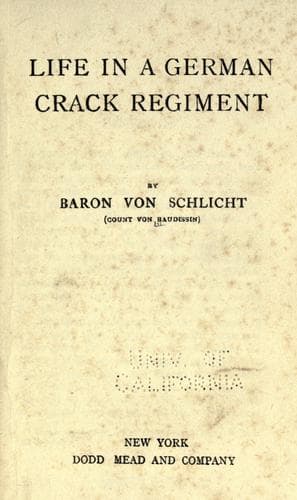
Life in a German Crack RegimentBaudissin, Wolf Ernst Hugo Emil, Graf von
General
Life in a German Crack Regiment
Baudissin, Wolf Ernst Hugo Emil, Graf von
Germany. Heer -- Military life -- Fiction; Soldiers -- Fiction
"Look at these, Olga, you need not read the names, they are of no
interest to you. Here is written: 'Herewith I pledge my word of
honour to return the loan of five hundred marks within the next three
months at latest.' 'Herewith I give my word of honour to return the
thousand marks lent me to-day within----' and on, dear. Dozens of
these documents are lying here; dozens of unredeemed pledges given on
their word of honour, and yet these very men who have broken their
pledge are going about in the world as haughty officers." He was
silent for a moment, then he said, "By Jove! these lieutenants are
quite different from other people; to a certain extent they form a
class by themselves, and their ignorance and lack of understanding
in certain matters are really more than _naïve_. I confess I don't
understand these aristocratic persons, and because I don't understand
them I can find no excuse for their doings and acts, their thoughts
and their feelings. I can forgive them for what they have done to me,
difficult though that is, but I can scarcely endure their fine airs
in Society, especially when there is scarcely any other class whose
general education is so poor and lamentable as that of the officers.
I was indeed nearly going to say they could neither read nor write
properly."
"Now, now, George," admonished Olga, "you must not exaggerate because
you are angry."
"I am not angry, I am only sad that things are so bad with our
officers. But I really believe I have under-stated the case. The
lieutenants can read, but can they also write? Look at these begging
letters and promissory notes which I just showed you; you will
find beauties of style there, compared with which those of the
everlasting fourth-form boy of the comic papers are mere nothings.
But that is not all. You will find such spelling as would bring down
public rebuke upon a third-form boy. You may laugh, Olga, but what
I tell you is the sad fact. Of course, my remarks only referred to
the lieutenants, and not to the superior officers, but how often
have I not noticed even among them how terribly embarrassed they
are if they have to make a report suddenly. Every word is such an
effort to them that one feels truly sorry for them. Yet, in spite
of all this, in spite of the lack of the simplest culture, all this
arrogance and self-complacence! Naturally, every one ought to be
proud of his calling, but this pride ought not to degenerate into a
perfectly fanatical arrogance. Formerly people spoke of the young,
well-educated, knightly lieutenants, the perfect cavaliers. Where
are they now? You must go with a lantern and search for them. I
have scarcely known one during my time of service, and the few who
enter the army straight from their home, fresh and unspoiled, are
only too quickly infected with the spirit of caste, and the demon
of haughtiness takes possession of them. Ask the parents whose sons
have become officers whether they are not often shocked at the
Public-domain text, read in full here on John Shaqi.
Reviews
Reviews
No reviews yet
Be the first to share your thoughts on this work.
Elsewhere in the archive
Join the Discussion
Join the discussion
Sign in to leave a comment or review.
Sign InorCreate an account