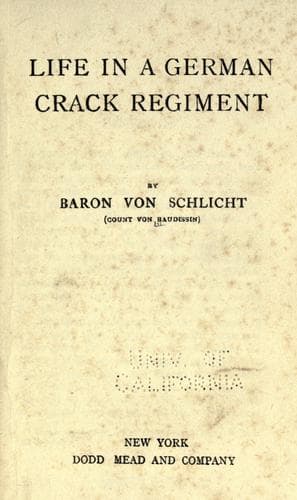
Life in a German Crack RegimentBaudissin, Wolf Ernst Hugo Emil, Graf von
General
Life in a German Crack Regiment
Baudissin, Wolf Ernst Hugo Emil, Graf von
Germany. Heer -- Military life -- Fiction; Soldiers -- Fiction
conceit and pretentiousness of the young fellows for whom the best
is not considered good enough; whether they have not often bitterly
repented having allowed their sons to choose a profession which
often estranges them from their own parents, who are too often only
regarded as the source of money for their frivolous or luxurious
lives."
"George, you are exaggerating absurdly," said Olga, rebukingly.
"Do you really think so? I can only say I have often known young
lieutenants who are really ashamed because their fathers are teachers
or something similar, but in spite of this they are not ashamed to
send home for more money in order to maintain a good appearance. They
wish--no, according to their view they _must_ give the idea of coming
from good families. I was once at dinner and I heard with my own ears
how a lieutenant pretended his father was a pensioned officer because
he felt embarrassed at having to say he was a doctor."
"Fi, that's a beautiful idea."
Count Wettborn had, therefore, an easy task when he came to persuade
George to go on furlough. He was much astonished when he heard that
George was quite determined to send in his resignation, and to enter
his father's factory; but, naturally, he made no attempt to dissuade
him.
"And when do you think of sending in your request?"
"In a day or two. My father writes to me that he is commanded to an
audience with His Majesty, and that he will be here at the beginning
of next week. Although I am a completely free agent in this matter,
and can go and come as I like, still I think it is my duty to inform
my father of my resolution as soon as possible."
"Certainly, certainly," agreed Count Wettborn, "a week sooner or
later makes no difference."
And that was just what the officers thought when they heard that
Winkler was going. Whether he remained a week more or less--that was
a matter of no importance--the thing was, they were going to get rid
of him.
"I say, boys, we'll be a little bit nice to him during these last few
days," suggested one of the officers. "We will behave as if we were
rather sorry that he's going, for, after all, it's not exactly his
fault that he doesn't suit us. Besides, it would be a good thing for
us if the memory of his last days among us was a pleasant one; later
on he will often tell stories of the days when he had the honour of
belonging to us, and although, of course, it doesn't really matter
what he says about us to his shopkeeper friends, still, it won't do
us any harm if he says, 'The "Golden Butterflies" are a damned fine
regiment; they're a charming set of good-hearted, dear fellows who
are second to none in their friendliness and good fellowship.'"
But the proposal evoked no response. "For his own sake he won't say
much about his dealings with us and how we drove him out."
But they all agreed, however, to drop every appearance of ill-will
and to be, at least outwardly, polite and amiable during these last
days.
Public-domain text, read in full here on John Shaqi.
Reviews
Reviews
No reviews yet
Be the first to share your thoughts on this work.
Elsewhere in the archive
Join the Discussion
Join the discussion
Sign in to leave a comment or review.
Sign InorCreate an account