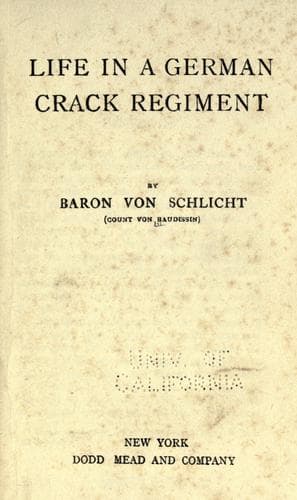
Life in a German Crack RegimentBaudissin, Wolf Ernst Hugo Emil, Graf von
General
Life in a German Crack Regiment
Baudissin, Wolf Ernst Hugo Emil, Graf von
Germany. Heer -- Military life -- Fiction; Soldiers -- Fiction
"Twice I meant to do so, but I should have had to inquire how the
Warnows were, and, of course, that would be very disagreeable for me."
"But how do you stand with regard to her," his father asked for the
second time. "You know your mother has prophesied for a long time
that you were going to get engaged to her. Is she right?"
"As you ask me straight out, I will tell you that at first I had the
same idea, and I think that if this horrible business had not come
between us, and if we had seen one another more often, things would
have been all right, but now----"
Elsa saw such a sorrowful and despairing look in her brother's face
that she said to him, "But won't you find it very hard to go away
without seeing her again?"
"I shall see her once again," answered George, with determination. "I
shall pay a farewell visit. I shall ask Hildegarde to name an hour
when I am sure to see her." And then, acting on a sudden impulse, he
said: "By the way, Elsa, I told Hildegarde all sorts of things about
you. I told her you wanted to become acquainted with her, and she
was delighted. Will you do me a favour and call upon her, or, better
still, ask her to call upon you at the hotel? I will be there, too,
and then when we meet again after several weeks we shall know what we
feel towards one another, and if Hildegarde loves me, then----"
"Not so fast, my boy, not so fast," put in the old man. "I am still
in existence. I should like to see my future daughter-in-law before I
am called up to consent and say 'Amen.'"
George had a sudden vision of Hildegarde; the memory of the
delightful hours they had spent together awakened in him a great
longing to see her again.
"Oh, you will like Hildegarde, father, she is beautiful and good,
and in spite of her aristocratic birth she does not share the often
extraordinary views of her class. I have told her a great deal
about you, father; about the factory, your consideration for your
workpeople, your ceaseless activity, and she was interested in
and understood everything." He spoke of her with an ardour and an
enthusiasm which showed how much he cared for her.
"And what sort of a family has she?" inquired old Winkler. "You know
I don't care whether she has money or not--you need not trouble about
that--what I mean is, do you know anything about her relations? Has
she any brothers and sisters? What are her parents?"
George gave what information he could.
"Oh, so there's a scamp of a lieutenant," grumbled the father;
"instead of parents who have no money making their son learn some
business or other, the young fellows have to become officers, so that
they may get drunk on champagne at the regimental banquet."
"But Hildegarde cannot help that," George said, as if he had to
protect her: "and what does her brother matter to me?"
Public-domain text, read in full here on John Shaqi.
Reviews
Reviews
No reviews yet
Be the first to share your thoughts on this work.
Elsewhere in the archive
Join the Discussion
Join the discussion
Sign in to leave a comment or review.
Sign InorCreate an account