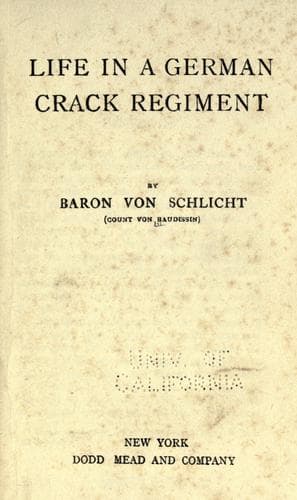
Life in a German Crack RegimentBaudissin, Wolf Ernst Hugo Emil, Graf von
General
Life in a German Crack Regiment
Baudissin, Wolf Ernst Hugo Emil, Graf von
Germany. Heer -- Military life -- Fiction; Soldiers -- Fiction
"What does he matter? Well"--the old man got up--"a man does not only
marry a wife, but the whole family, take that from me, my boy, and
so, before taking any steps, we must look into things a bit. But I
will frankly confess one thing to you: I have privately long desired
you to marry. It's all the same to me whom, as long as you love her.
Well, now we can go and see your Hildegarde."
CHAPTER XI
FAREWELL TO THE ARMY!
"MY son just engaged to your daughter. For Hildegarde's sake will
try to assist you and your son. Expect you both to-morrow for
consultation on subject."
This telegram sent off by the old manufacturer caused indescribable
excitement in the major's home; weeping with joy and agitation the
husband and wife flung themselves into each other's arms and blessed
the day on which Heaven had given them Hildegarde.
"A fine girl, a good girl," said the major a dozen times over, and if
there was anything that troubled his intense joy it was that Hilda
was not with them. He would so much have liked to take her in his
arms, and in his somewhat rough fashion to have patted her on the
shoulder and said: "You have done well, my girl."
He laughed hoarsely, and lit the dearest cigar he had in the house.
One ought to make merry on festivals whenever they occur, and to-day
was truly a festival: Hildegarde engaged to the son of one of the
richest wholesale manufacturers, that was indeed more than mere
good luck, and almost unconsciously the major folded his hands and
thanked the good God for having sent him so rich a son-in-law. He
read and re-read the telegram; he could not at once take in the whole
extent of the joyful news, and the oftener he read the telegram and
the more calmly he gradually accepted its contents, the more he took
exception each time to the words: "For Hildegarde's sake will try
to assist you and your son. Expect you both to-morrow." What did
that mean--will try; it was not a question of _will_, but _must_.
Did this _parvenu_ imagine, perhaps, that the major would give his
beautiful child, his only daughter, to his son without his having to
pay heavily for it? Oh, no, indeed! No gains without pains; if the
honorary commercial adviser did not pay his debts and his son's, then
there would be no engagement, for he, as father, would never give his
consent. That would indeed be a fine thing if he gave his child to
the first best suitor without any compensation. "No, no, that's not
what was intended, that won't do at all."
Public-domain text, read in full here on John Shaqi.
Reviews
Reviews
No reviews yet
Be the first to share your thoughts on this work.
Elsewhere in the archive
Join the Discussion
Join the discussion
Sign in to leave a comment or review.
Sign InorCreate an account