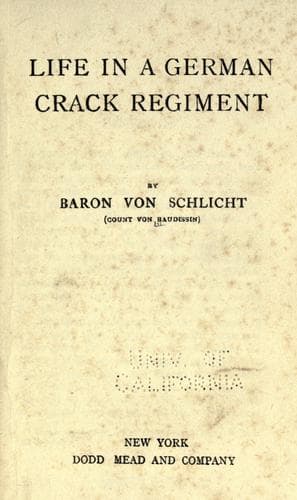
Life in a German Crack RegimentBaudissin, Wolf Ernst Hugo Emil, Graf von
General
Life in a German Crack Regiment
Baudissin, Wolf Ernst Hugo Emil, Graf von
Germany. Heer -- Military life -- Fiction; Soldiers -- Fiction
In the conversation that had taken place between Hildegarde and
Elsa, the former had considered it her duty to tell her new friend
frankly about her family affairs, and to confess quite plainly how
she had been sent year after year to Berlin to get a rich husband.
With tears she confessed she loved George, but declared she must
renounce him, for she could not endure that George should believe,
even for a moment, that she loved him for his money. At first when
Elsa heard this she assumed a somewhat distant air, then she felt the
most sincere sympathy for Hildegarde, whose every word showed clearly
and distinctly how good and true she was. Elsa tried to console her
to the best of her ability, and assured her that George would not
doubt her, but that his love would be all the greater when he heard
what a sad life she had had. Elsa undertook to inform her father
what Hildegarde had told her, and at the first moment he was quite
overcome, and kept on saying to his son--"George, leave the thing
alone, give up all thoughts of Hildegarde, don't be drawn into that
wretched family affair." But he made no further opposition after
he had seen Hildegarde and had had an hour's conversation with her
_tête-à-tête_. He took his son aside and said, "George, the girl's an
angel, we must make her happy and compensate her for all she has gone
through by a future without a care or worry."
So they had all taken counsel together as to how Hildegarde's
relatives were to be helped. Hildegarde had told them the extent of
the debts so far as she remembered it from her last visit home, and
at last it was arranged that old Winkler should pay one half of the
debts, and George, out of his own income, the other. Besides this,
Winkler intended to put aside a certain sum every year, from which
Hildegarde could make her parents an allowance, and so they would be
removed from all pecuniary anxiety.
It was more difficult to arrange what was to be done about Fritz.
George wanted to pledge himself to give his brother-in-law a monthly
allowance, but Hildegarde shook her head at this. "There is really
no object in doing that, George. If, in your kindness, you were to
give him thousands and thousands, it would be so much money thrown
away. The more Fritz has the more he needs. He would never manage on
whatever he had; he would always borrow from us, he would not stop
gambling, and if we wouldn't help him he would borrow on I O U's,
and would soon be as deeply in debt as he is to-day. It is sad for
his own sister to have to say this, but I can only see one way of
helping Fritz--he must leave the army and go abroad. He will never
be any better until he works and earns his own living and so gets to
understand the value of money."
Public-domain text, read in full here on John Shaqi.
Reviews
Reviews
No reviews yet
Be the first to share your thoughts on this work.
Elsewhere in the archive
Join the Discussion
Join the discussion
Sign in to leave a comment or review.
Sign InorCreate an account