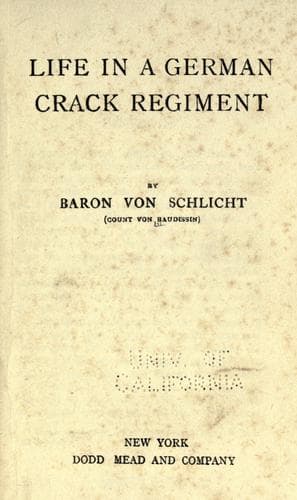
Life in a German Crack RegimentBaudissin, Wolf Ernst Hugo Emil, Graf von
General
Life in a German Crack Regiment
Baudissin, Wolf Ernst Hugo Emil, Graf von
Germany. Heer -- Military life -- Fiction; Soldiers -- Fiction
"Hildegarde is right," agreed the old manufacturer. "Hildegarde is
certainly the most sensible girl I have ever known, and if she, who
knows her brother so well, says that there is no other means of
helping him except a change of climate, then he shall have it. Let
him go to America, I have business connections there, and can easily
get him a post. He shall not starve, I will see to that all right,
but he shall only get as much money as will keep him from want. He
will therefore be forced to work for his living."
Thus all was settled and arranged when the major and his son arrived,
and at the sight of the absolute calmness and firm determination
which were visible in the manufacturer's whole bearing, they were
quite unable to carry out their proposal and take the high hand. They
could not explain why, but as they sat with the old man, they were
almost ill at ease when he asked them about their debts, and told
them in what way he proposed to settle them.
Fritz could hardly believe his ears when he was told he was to leave
the army. He opposed it as much as ever he could, but he was so
deeply involved that he could not hang on for more than a few weeks.
It would, therefore, be best for him after all to resign at once. But
if he left the army there was really no object in paying his debts at
once; the people could wait for them, he would be quite content to
go on owing them money. He made this clear to old Winkler, who might
thus save the money and give him a few more thousand marks for his
journey.
"For you to gamble them away on board ship. No, there's no sense
in that, and quite apart from that, in our plebeian circles it is
considered honourable to fulfil one's obligations. Surely you, who
belong to a class which is nicknamed nowadays 'the first class,'
ought not to think differently in this matter. I should not have
expected this of you."
Fritz could not help feeling uncomfortable, and both father and son
were delighted when Elsa inquired whether lunch could not be served,
and so brought the conversation to an end.
The major was in the seventh heaven: his debts were paid, he received
an extra allowance, he had no longer any need to give his son any
money, and henceforth he could live free from care. He did not, of
course, quite like it that his son Fritz should have to go abroad,
but if the old manufacturer insisted upon it, why one must agree
to it, and perhaps he might find a rich wife there. In America
there were still people who thought aristocratic birth more than
out-weighed gold, and, besides, America was not far off, he could be
back again in a few days, if need be. He whispered all this to his
son, when he was alone with him for a moment, and Fritz made the best
of a bad bargain. Father and son thoroughly enjoyed the excellent
luncheon of which they all partook, and appeared to take no notice of
the somewhat cold, distant behaviour of the Winklers at the beginning
of the interview.
Public-domain text, read in full here on John Shaqi.
Reviews
Reviews
No reviews yet
Be the first to share your thoughts on this work.
Elsewhere in the archive
Join the Discussion
Join the discussion
Sign in to leave a comment or review.
Sign InorCreate an account