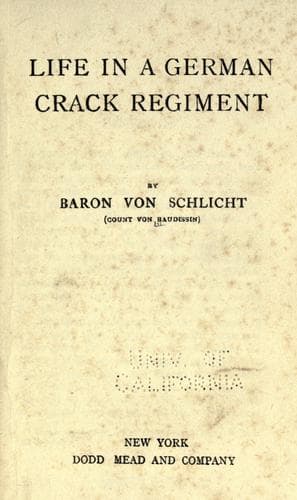
Life in a German Crack RegimentBaudissin, Wolf Ernst Hugo Emil, Graf von
General
Life in a German Crack Regiment
Baudissin, Wolf Ernst Hugo Emil, Graf von
Germany. Heer -- Military life -- Fiction; Soldiers -- Fiction
They spoke quite openly in the barracks about card-playing. It is
true it was forbidden, and indeed at regular intervals the most
stringent orders against playing for money were publicly read out,
and listened to with that respect which is proper for commands
emanating from such high places, but further than this no one
troubled about the prohibition. The military authorities knew all
about it, but they shut their eyes, and indeed it sometimes happened
that the colonels themselves played with their own officers. What
could the military authorities do? In a little garrison town it was
easy enough to see that an order was carried out, but in a large town
it was utterly impossible. The officers would play, and if they were
not allowed to play in the barracks or the mess-room, then they would
gamble in some club or in another regiment or in their own homes.
Whoever means to gamble will find an opportunity. Officially of
course, it was said, officers are not allowed to gamble; but one must
distinguish between gambling and gambling. If a fellow lost twenty
marks it didn't matter to anybody, and if he lost a hundred, what did
it matter? And if a man has the misfortune to lose a thousand marks
surely he isn't more liable to punishment than if he had only staked
twenty? If the military authorities intended to punish everybody
who touched a pack of cards, then the number of officers in any one
year would be reduced by half. The lieutenants who played would, of
course, be punished, and the colonels in whose regiments gambling
went on would run the risk of dismissal because they had not seen
that the stringent regulations concerning gambling were carried out.
Now, a man who is a colonel naturally wishes to become a general,
and he is not likely to risk his military reputation by giving
information which he can suppress if he likes.
Little Willberg repeated the question which the Uhlan at first
thought it beneath his dignity to answer. At last he looked at him
somewhat astonished: "You had better take care, you will lose your
money; are you so very rich that you don't mind losing it?"
Willberg slapped his pockets cheekily: "They're quite full to-day,
I've just had a remittance."
Willberg could not account for it, but suddenly he had an odd
feeling. It had taken a long time to squeeze a thousand marks out
of his old father to pay some of his most pressing debts. He had
therefore the feeling that it was not quite right to risk any on
a game of cards, but he would rather have died than confessed it
now. Had he done so he would have for ever blamed himself and
made himself supremely ridiculous in the sight of those beautiful
patent-leather boots and silver spurs, which were the things that
impressed him most in the Uhlan. However, he determined not to risk
more than half of his cash; if he lost that, then the affair was
over, if he won, then he would reconsider matters.
Public-domain text, read in full here on John Shaqi.
Reviews
Reviews
No reviews yet
Be the first to share your thoughts on this work.
Join the Discussion
Join the discussion
Sign in to leave a comment or review.
Sign InorCreate an account