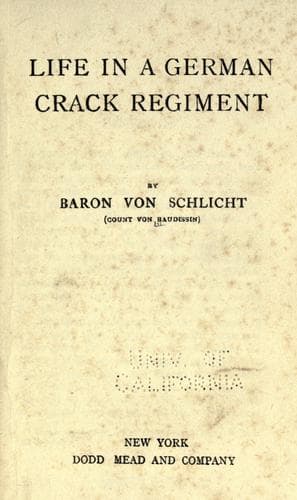
Life in a German Crack RegimentBaudissin, Wolf Ernst Hugo Emil, Graf von
General
Life in a German Crack Regiment
Baudissin, Wolf Ernst Hugo Emil, Graf von
Germany. Heer -- Military life -- Fiction; Soldiers -- Fiction
SEVERAL weeks passed and George was still "sent to Coventry by the
regiment," as he called it. He still had not a single friend with
whom he had any close relations. His hope that Willberg, whom he had
helped out of his difficulty, would get on more friendly terms with
him, was not fulfilled. On the contrary, the latter had less to do
with him than usual, although he had not yet paid his debt. George
did not trouble about this. He had already had many disagreeable
experiences in these matters in his old regiment; but as he himself
had grown up in quite different circumstances, he did not really
grasp the attitude of the "Golden Butterflies" with regard to money.
They had no hesitation, even in the presence of the orderlies, in
borrowing from each other. Very often, indeed, they made no scruples
about saying to their servants: "Spend this or that amount on my
behalf," but the money was not always returned to the orderly the
same day. They got credit wherever they could, and borrowed from
all possible sources. In the chief restaurant, where they often
passed the evenings rather than stay at home in barracks, many of
the officers owed the waiter fifty or sixty marks actually in cash,
besides what they owed for food and drinks. And it was just those who
owed the waiter most, who lived most extravagantly, ate the dearest
food and drank the most expensive wine, and when they went off it
was always, "Muller, put down twenty marks to my account, you know
you'll get it all right." But the question was, when? Some of the
officers had owed this money for months, and they never thought of
paying back; so long as they wore a uniform, surely the money was
safe enough. George noticed with astonishment that the officers in
Berlin were just as lax in these matters as they had been in his
former regiment. Once in the little garrison town, in a restaurant
much frequented by the military, there was a row with the landlord;
the officers boycotted the place and swore that the fellow shouldn't
get another penny from them. But not a single one of them thought of
paying his debts, part of which were due to the landlord, part to
the waiter. It was only when the landlord complained to the colonel
that he obtained redress, but even then it was in a curious manner.
The colonel did not order his officers to pay their debts within
twenty-four hours, but he gave them six weeks in which to discharge
their liabilities. And so the landlord and the waiter, who really
needed their money, had to wait patiently all that time.
Public-domain text, read in full here on John Shaqi.
Reviews
Reviews
No reviews yet
Be the first to share your thoughts on this work.
Join the Discussion
Join the discussion
Sign in to leave a comment or review.
Sign InorCreate an account