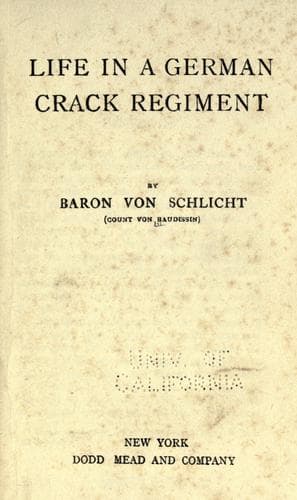
Life in a German Crack RegimentBaudissin, Wolf Ernst Hugo Emil, Graf von
General
Life in a German Crack Regiment
Baudissin, Wolf Ernst Hugo Emil, Graf von
Germany. Heer -- Military life -- Fiction; Soldiers -- Fiction
Hildegarde was somewhat embarrassed at these words. Then he had also
told his people about her, perhaps even he had confessed that he
meant to win her hand. The remembrance of her brother's letter came
back to her. She must tell him all before it was too late. How was
she to do it? Nobody was paying any attention to their conversation,
but how was she to express what she wanted to say? As he had not told
her what his intentions were, she could not very well say to him:
"Don't think of wooing; on account of my family I will not and cannot
be your wife." And yet if without further explanations she spoke
about their poverty at home, might it not occur to him that perhaps
she expected help from him or his father. She could find no way out
of the difficulty. Then she wondered why he had never spoken to her
about his sister. She was much astonished, and at last she said:
"Have you a sister, then, Lieutenant Winkler? Why did you never tell
me about her?"
He looked at her surprised: "What! did I never tell you about her?
You mustn't take that amiss, for I had no intention of not talking
about her to you."
"And why should you not talk about her to other people?" she
inquired, with some curiosity.
George was embarrassed, and blushed like a child. "I can't exactly
explain it. Perhaps it is that when one loves anybody very much one
does not speak much about them to anyone. And even if I had wanted
to talk about her, to whom should I have talked? In the regiment no
one takes the faintest interest in me, far less in my family, and
naturally, I don't talk about such matters unless I am asked." Then,
after a slight pause, he continued: "And there's another reason why I
don't care to talk about Elsa."
"And what is that?" Hildegarde asked, as he was silent.
"I don't know how to express in words exactly what I want to say. I
don't want to appear suspicious of my comrades, neither do I wish
to represent myself as a model of virtue, which, indeed, I am not,
and could not be, at twenty-seven years old. But I can't help saying
that at mess my fellow-officers have a way of talking about young
girls, whom they meet in Society, which is simply revolting to me.
No, not revolting, that's too strong," he corrected himself. "I
am simply astounded, and constantly say to myself: 'Haven't these
officers sisters, and haven't their mothers taught them any respect
and reverence for women; so that they don't treat all alike?' In my
old regiment it was quite different; we were not perhaps more moral
men, but in the little town where we were brought into such close
relationship with the few families, we could not criticise the young
girls so freely and so shamelessly. I remember how once at dinner
an officer went so far as to make an insulting remark about one of
the ladies. The orderlies were sent out of the room, and the oldest
officer at the table, an old captain, read the young lieutenant such
a lecture before us all, that he never said a single word in excuse."
Public-domain text, read in full here on John Shaqi.
Reviews
Reviews
No reviews yet
Be the first to share your thoughts on this work.
Join the Discussion
Join the discussion
Sign in to leave a comment or review.
Sign InorCreate an account