They say that Christ is the prophet of the weak, and on the contrary He
came to give strength to the languishing, and to raise up those trodden
under foot to be higher than kings. They say that His is the religion of
the sick and of the dying, and yet He heals the sick and brings the
sleeping to life. They say that He is against life, and yet He conquers
death; that He is the God of sadness, and yet He exhorts His followers
to be joyful and promises an everlasting banquet of joy to His friends.
They say that He introduced sadness and mortification into the world,
and on the contrary when He was alive He ate and drank, and let His feet
and hair be perfumed, and detested hypocritical fasts, and the
penitential mummeries of vanity. Many have left Him because they never
knew Him. This book is especially for such readers.
This book is written, if you will pardon the mention, by a Florentine, a
son of the only nation which ever chose Christ for its King. Savonarola
first had the idea in 1495, but could not carry it through. In spite of
a threatening siege, it was taken up in 1527 and approved by a great
majority. Over the door of the Palazzo Vecchio, between Michael Angelo’s
David and Bandinelli’s Hercules, a marble tablet was built into the
wall, with these words:
JESUS CHRISTUS REX FLORENTINI
POPULI P. DECRETO ELECTUS.
Although changed by Cosimo, this inscription is still there; the decree
was never formally abrogated and denied, and even to-day after four
hundred years of usurpations, the writer of this book is proud to call
himself a subject and soldier of Christ the King.
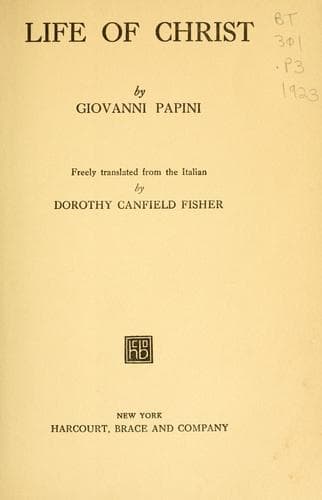
LIFE OF CHRIST
Jesus was born in a stable, a real stable, not the bright, airy portico
which Christian painters have created for the Son of David, as if
ashamed that their God should have lain down in poverty and dirt. And
not the modern Christmas-eve “Holy Stable” either, made of plaster of
Paris, with little candy-like statuettes, the Holy Stable, clean and
prettily painted, with a neat, tidy manger, an ecstatic Ass, a contrite
Ox, and Angels fluttering their wreaths on the roof—this is not the
stable where Jesus was born.
A real stable is the house, the prison of the animals who work for man.
The poor, old stable of Christ’s old, poor country is only four rough
walls, a dirty pavement, a roof of beams and slate. It is dark, reeking.
The only clean thing in it is the manger where the owner piles the hay
and fodder.
Public-domain text, read in full here on John Shaqi.
Reviews
Reviews
No reviews yet
Be the first to share your thoughts on this work.
Join the Discussion
Join the discussion
Sign in to leave a comment or review.
Sign InorCreate an account