Composers -- Austria -- Biography; Mozart, Wolfgang Amadeus, 1756-1791
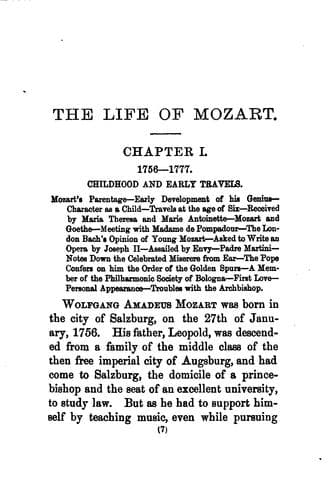
Wolfgang Amadeus Mozart was born in the city of Salzburg, on the 27th
of January, 1756. His father, Leopold, was descended from a family
of the middle class of the then free imperial city of Augsburg, and
had come to Salzburg, the domicile of a prince-bishop and the seat
of an excellent university, to study law. But as he had to support
himself by teaching music, even while pursuing his legal studies,
he was soon compelled to enter entirely into the service of others.
He became _valet de chambre_ to a canon of the Roman church, Count
Thurm; afterwards court-musician and then _capellmeister_[1] to
the archbishop. He had married in 1747 a young girl, educated in a
neighboring convent. Himself and wife were considered the handsomest
couple in Salzburg in their day. Of seven children born to them, they
lost all but two, Maria Anna, known by the pet-name of Nannerl, and our
Wolfgang, most frequently called Wolferl. Anna was about five years
older than Wolfgang, and both gave evidence, from the time they were
little children, of an extraordinary talent for music.
An old friend of the family tells us how, from the moment young Mozart
had begun to give himself to music, he cared neither to see nor hear
anything else. Even his childish games and plays did not interest
him unless accompanied by music. “Whenever,” says our informant, “we
carried our toys from one room to another, the one of us who had
nothing to carry was always required to play, or sing a march,” ...
and further: “He [Mozart] grew so extremely attached to me because
I kept him company and entered into his childish humors, that he
frequently asked me ten times in a day, if I loved him; and when I
sometimes said no, only in fun, the tears instantly glistened his eyes,
his little heart was so kind and tender.”
We learn from the same source that he manifested no pride or awe, yet
he never wished to play except before great connoisseurs in music;
and to induce him to do so it was sometimes necessary to deceive him
as to the musical acquirements of his hearers. He learned every task
that his father gave him, and put his soul so entirely into whatever
he was doing that he forgot all else for the time being, not excepting
even his music. Even as a child, he was full of fire and vivacity, and
were it not for the excellent training he received from his father,
who was very strict with him, and of a serious turn of mind, he might
have become one of the wildest of youths, so sensitive was he to the
allurements of pleasure of every kind, the innocence or danger of which
he was not yet able to discover.
Public-domain text, read in full here on John Shaqi.
Reviews
Reviews
No reviews yet
Be the first to share your thoughts on this work.
Join the Discussion
Join the discussion
Sign in to leave a comment or review.
Sign InorCreate an account