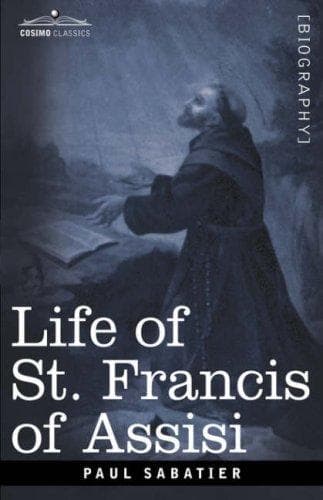
Christian saints -- Biography; Francis, of Assisi, Saint, 1182-1226
But that which is a truism, so far as men of genius in the domain of
imagination or thought are concerned, still appears like a paradox when
we speak of men of religious genius. The Church has laid such absolute
claim to them that she has created in her own favor a sort of right. It
cannot be that this arbitrary confiscation shall endure forever. To
prevent it we have not to perform an act of negation or demolition: let
us leave to the chapels their statues and their relics, and far from
belittling the saints, let us make their true grandeur shine forth.
* * * * *
It is time to say a few words concerning the difficulties of the work
here presented to the public. History always embraces but a very feeble
part of the reality: ignorant, she is like the stories children tell of
the events that have occurred before their eyes; learned, she reminds us
of a museum organized with all the modern improvements. Instead of
making you see nature with its external covering, its diffuse life, its
mysterious echoes in your own heart, they offer you a herbarium.
If it is difficult to narrate an ordinary event of our own time, it is
far more so to describe the great crises where restless humanity is
seeking its true path.
The first duty of the historian is to forget his own time and country
and become the sympathetic and interested contemporary of what he
relates; but if it is difficult to give oneself the heart of a Greek or
a Roman, it is infinitely more so to give oneself a heart of the
thirteenth century. I have said that at that period the Middle Age was
twenty years old, and the feelings of the twentieth year are, if not the
most fugitive, at least the most difficult to note down. Everyone knows
that it is impossible to recall the feelings of youth with the same
clearness as those of childhood or mature age. Doubtless we may have
external facts in the memory, but we cannot recall the sensations and
the sentiments; the confused forces which seek to move us are then all
at work at once, and to speak the language of beyond the Rhine, it is
_the essentially phenomenal hour of the phenomena that we are;_
everything in us crosses, intermingles, collides, in desperate conflict:
it is a time of diabolic or divine excitement. Let a few years pass, and
nothing in the world can make us live those hours over again. Where was
once a volcano, we perceive only a heap of blackened ashes, and
scarcely, at long intervals, will a chance meeting, a sound, a word,
awaken memory and unseal the fountain of recollection; and even then it
is only a flash; we have had but a glimpse and all has sunk back into
shadow and silence.
We find the same difficulty when we try to take note of the fiery
enthusiasms of the thirteenth century, its poetic inspirations, its
amorous and chaste visions--all this is thrown up against a background
of coarseness, wretchedness, corruption, and folly.
Public-domain text, read in full here on John Shaqi.
Reviews
Reviews
No reviews yet
Be the first to share your thoughts on this work.
Join the Discussion
Join the discussion
Sign in to leave a comment or review.
Sign InorCreate an account