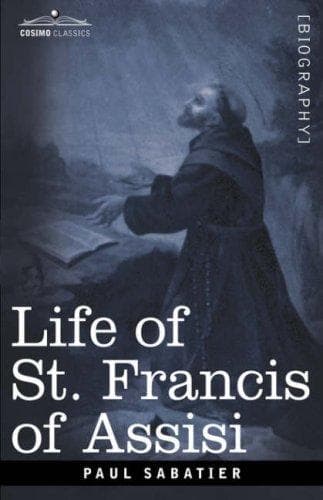
Christian saints -- Biography; Francis, of Assisi, Saint, 1182-1226
From the very beginning Egidio's life commanded respect; it was at once
so original, so gay, so spiritual,[7] and so mystical, that even in
the least exact and most expanded accounts his legend has remained
almost free from all addition. He is, after St. Francis, the finest
incarnation of the Franciscan spirit.
The incidents which are here cited are all, so to speak, illustrations
of the Rule; in fact there is nothing more explicit than its commands
with respect to work.
The Brothers, after entering upon the Order, were to continue to
exercise the calling which they had when in the world, and if they had
none they were to learn one. For payment they were to accept only the
food that was necessary for them, but in case that was insufficient they
might beg. In addition they were naturally permitted to own the
instruments of their calling.[8] Brother Ginepro, whose acquaintance
we shall make further on, had an awl, and gained his bread wherever he
went by mending shoes, and we see St. Clara working even on her
death-bed.
This obligation to work with the hands merits all the more to be brought
into the light, because it was destined hardly to survive St. Francis,
and because to it is due in part the original character of the first
generation of the Order. Yet this was not the real reason for the being
of the Brothers Minor. Their mission consisted above all in being the
spouses of Poverty.
Terrified by the ecclesiastical disorders of the time, haunted by
painful memories of his past life, Francis saw in money the special
instrument of the devil; in moments of excitement he went so far as to
execrate it, as if there had been in the metal itself a sort of magical
power and secret curse. Money was truly for him the sacrament of evil.
This is not the place for asking if he was wrong; grave authors have
demonstrated at length the economic troubles which would have been let
loose upon the world if men had followed him. Alas! his madness, if
madness it were, is a kind of which one need not fear the contagion.
He felt that in this respect the Rule could not be too absolute, and
that if unfortunately the door was opened to various interpretations of
it, there would be no stopping-point. The course of events and the
periodical convulsions which shook his Order show clearly enough how
rightly he judged.
I do not know nor desire to know if theologians have yet come to a
scientific conclusion with regard to the poverty of Jesus, but it seems
evident to me that poverty with the labor of the hands is the ideal held
up by the Galilean to the efforts of his disciples.
Public-domain text, read in full here on John Shaqi.
Reviews
Reviews
No reviews yet
Be the first to share your thoughts on this work.
Elsewhere in the archive
Join the Discussion
Join the discussion
Sign in to leave a comment or review.
Sign InorCreate an account