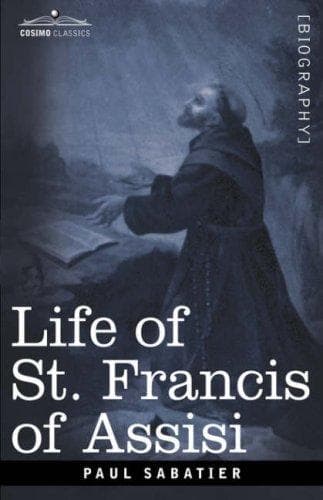
Christian saints -- Biography; Francis, of Assisi, Saint, 1182-1226
[2] The Reformation only substituted the authority of the book
for that of the priest; it is a change of dynasty and nothing
more. As to the majority of those who to-day call themselves
free-thinkers, they confuse religious freedom with irreligion;
they choose not to see that in religion as in politics, between
a royalty based on divine right and anarchy there is room for a
government which may be as strong as the first and a better
guarantee of freedom than the second. The spirit of the older
time put God outside of the world; the sovereignty outside of
the people; authority outside of the conscience. The spirit of
the new times has the contrary tendency: it denies neither God
nor sovereignty nor authority, but it sees them where they
really are.
[3] _Nemo ostendebat mihi quod deberem facere, sed ipse
Altissimus revelavit mihi quod deberem vivere secundem formam
sancti Evangelii._ Testamentum Fr.
[4] The wealthiest monasteries of France are of the twelfth
century or were enlarged at that time: Arles, S. Gilles, S.
Sernin, Cluny, Vezelay, Brioude, Issoire, Paray-le-Monial. The
same was the case in Italy.
Down to the year 1000, 1,108 monasteries had been founded in
France. The eleventh century saw the birth of 326 and the
twelfth of 702. The convents of Mount Athos in their present
state give us a very accurate notion of the great monasteries of
Europe at the close of the twelfth century.
[5] St. Petrus Chrysologus, sermo viii., de jejunio et
eleemosyna. _Da pauperi ut des tibi: da micam ut accipias totum
panem; da tectum, accipe coelum._
[6] By what right did he begin to preach? By what right did he,
a mere deacon, admit to profession and cut off the hair of a
young girl of eighteen? That is an episcopal function, one which
can only devolve even upon priests by an express commission.
[7] Isaiah i. 10-17. Cf. Joel 2, Psalm 50.
[8] The chronicles of Orvieto (_Archivio, storico italiano_, t.
i., of 1889, pp. 7 and following) are nothing more than a list,
as melancholy as they are tedious of wars, which, during the
thirteenth and fourteenth centuries, all the places of that
region carried on, from the greatest to the smallest.
[9] Do not forget that in the thirteenth century Italy was not a
mere geographical expression. It was of all the countries of
Europe the one which, notwithstanding its partitions, had the
clearest consciousness of its unity. The expression _profectus
et honor Italiae_ often appeared from the pen of Innocent III.
See, for instance, the bull of April 16, 1198, _Mirari cogimur_,
addressed particularly to the Assisans.
Public-domain text, read in full here on John Shaqi.
Reviews
Reviews
No reviews yet
Be the first to share your thoughts on this work.
Join the Discussion
Join the discussion
Sign in to leave a comment or review.
Sign InorCreate an account