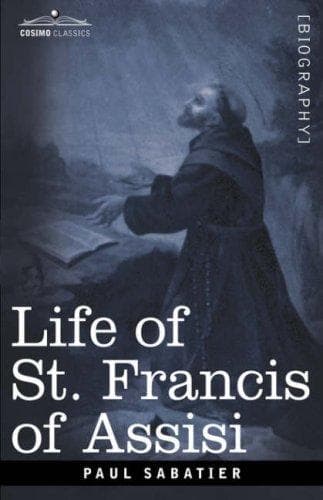
Christian saints -- Biography; Francis, of Assisi, Saint, 1182-1226
Ah, in his own conscience he well knew that the old ideal was the true,
the right one; but he drove away such thoughts as the temptations of
pride. The recent events had not taken place without in some degree
weakening his moral personality; from being continually talked to about
obedience, submission, humility, a certain obscurity had come over this
luminous soul; inspiration no longer came to it with the certainty of
other days; the prophet had begun to waver, almost to doubt of himself
and of his mission. Anxiously he searched himself to see if in the
beginning of his work there had not been some vain self-complacency. He
pictured to himself beforehand the chapter which he was about to open,
the attack, the criticisms of which it would be the object, and labored
to convince himself that if he did not endure them with joy he was not a
true Brother Minor.[14] The noblest virtues are subject to scruples,
that of perfect humility more than any other, and thus it is that
excellent men religiously betray their own convictions to avoid
asserting themselves. He resolved then to put the direction of the Order
into the hands of Pietro di Catana. It is evident that there was nothing
spontaneous in this decision, and the fact that this brother was a
doctor of laws and belonged to the nobility squarely argues the
transformation of the Franciscan institute.
It is not known whether or not Ugolini was present at the chapter of
September 29, 1220, but if he was not there in person he was assuredly
represented by some prelate, charged to watch over the debates.[15] The
bull which had been issued a week before was communicated to the friars,
to whom Francis also announced that he was about to elaborate a new
Rule. With reference to this matter there were conferences in which the
ministers alone appear to have had a deliberative voice. At these
conferences the essential points of the new Rule were settled as to
principle, leaving to Francis the care of giving them proper form at his
leisure. Nothing better reveals the demoralized state into which he had
fallen than the decision which was taken to drop out one of the
essential passages of the old Rule, one of his three fundamental
precepts, that which began with these words, "_Carry nothing with
you_."[16]
How did they go to work to obtain from Francis this concession which, a
little while before, he would have looked upon as a denial of his call,
a refusal to accept in its integrity the message which Jesus had
addressed to him? It is the secret of history, but we may suppose there
was in his life at this time one of those moral tempests which overbear
the faculties of the strongest, leaving in their wounded hearts only an
unutterable pain.
Something of this pain has passed into the touching narrative of his
abdication which the biographers have given us.
Public-domain text, read in full here on John Shaqi.
Reviews
Reviews
No reviews yet
Be the first to share your thoughts on this work.
Elsewhere in the archive
Join the Discussion
Join the discussion
Sign in to leave a comment or review.
Sign InorCreate an account