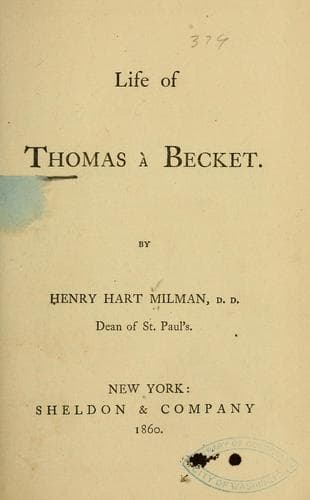
In November 1849, Mr. Milman, who had for some years been Rector of St.
Margaret's, Westminster, and a Canon of Westminster, was made Dean of
St. Paul's. Dean Milman's latest publication is a "History of Latin
Christianity, including that of the Popes to the Pontificate of Nicholas
V.," 3 vols. 8vo. 1854. This work is a continuation of the author's
"History of Christianity," and yet is in itself a complete work. To
give it that completeness he has gone over the history of Christianity
in Rome during the first four centuries. The author states that he is
occupied with the continuation of the history down to the close of the
pontificate of Nicholas V., that is, to 1455.[1] Besides the works
before mentioned, Dean Milman is understood to have contributed numerous
articles to the "Quarterly Review;" and his edition of Gibbon's "Decline
and Fall of the Roman Empire," presented the great historian with more
ample illustrations than he had before received. This edition has been
republished, with additional notes and verifications, by Dr. W. Smith.
Dean Milman is destined to become a household word in historical
literature, and we are glad to present the many with this favorable
specimen of his work.
May, 1859.
O. W. WIGHT.
LIFE OF THOMAS À BECKET.
[SN: Legend.]
Popular poetry, after the sanctification of Becket, delighted in
throwing the rich colors of marvel over his birth and parentage. It
invented, or rather interwove with the pedigree of the martyr, one of
those romantic traditions which grew out of the wild adventures of the
crusades, and which occur in various forms in the ballads of all
nations. That so great a saint should be the son of a gallant champion
of the cross, and of a Saracen princess, was a fiction too attractive
not to win general acceptance. The father of Becket, so runs the legend,
a gallant soldier, was a captive in the Holy Land, and inspired the
daughter of his master with an ardent attachment. Through her means he
made his escape; but the enamored princess could not endure life without
him. She too fled and made her way to Europe. She had learned but two
words of the Christian language, London and Gilbert. With these two
magic sounds upon her lips she reached London; and as she wandered
through the streets, constantly repeating the name of Gilbert, she was
met by Becket's faithful servant. Becket, as a good Christian, seems to
have entertained religious scruples as to the propriety of wedding the
faithful, but misbelieving, or, it might be, not sincerely believing
maiden. The case was submitted to the highest authority, and argued
before the Bishop of London. The issue was the baptism of the princess,
by the name of Matilda (that of the empress queen,) and their marriage
in St. Paul's, with the utmost publicity and splendor.
Public-domain text, read in full here on John Shaqi.
Reviews
Reviews
No reviews yet
Be the first to share your thoughts on this work.
Join the Discussion
Join the discussion
Sign in to leave a comment or review.
Sign InorCreate an account