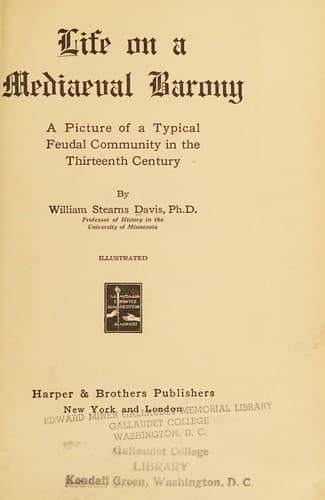
Life on a Mediaeval Barony: A Picture of a Typical Feudal Community in the Thirteenth CenturyDavis, William Stearns
History
Life on a Mediaeval Barony: A Picture of a Typical Feudal Community in the Thirteenth Century
Davis, William Stearns
Chivalry; Civilization, Medieval; Feudalism
As for Conon's family, his good mother, Lady Odelina, is now resting
under the stones of the abbey church; but she lived to see her
first-born wedded to Adela, the daughter of a rich Picard sire, a dame
of many virtues. The marriage has been blessed with two healthy sons,
François and Anseau--the pampered tyrants of all the castle folk.
The baron's household also includes his younger brother Aimery, who
has just reached the age for knighthood, and his marriageable sister
Alienor. So far the family had been marvelously harmonious. There has
been none of those passages at arms between elder and younger brothers
which often make a castle the antechamber to hell. Adela is "the very
_gentle_ dame"--beloved of husband and revered by vassals and villeins,
but whose "gentleness," like her husband's, by no means keeps her from
flogging her maids when their sins deserve it. Alienor is already going
to tourneys and has presented at least three young knights with her
stockings to tie to their lances; but she knows that it is a brother's
duty to find a husband for one's sister, and Conon has promised that
whoever he selects will be young, brave, and kindly. Therefore Alienor
is not borrowing trouble. As for Aimery, he is proud of being almost
as good a hawker and jouster as his brother. He will soon be knighted
and rule over Petitmur, but his head is full of a visit to the king's
court, of winning vast favor, and finally of being given the only
daughter and heiress of a great count--in short, of possessing a fief
bigger than St. Aliquis.
There, then, is the little world, ruled by persons perhaps a little
more honorable and kindly than the run of North French barons, but by
no means of impossible virtue.
It is June, A.D. 1220. The sun is just rising. Let us enter St. Aliquis
as the warders unbar the gates; for the castle is the heart of the
feudal civilization.
FOOTNOTES:
[1] Long before the assigned date of this narrative, some king
or other potentate had assuredly given the lords of St. Aliquis
_immunity_--_i.e._, exemption from ordinary jurisdiction, taxation,
etc., by outside powers, with corresponding privileges for the local
seigneurs themselves.
[2] On some fiefs, as on the royal domain at this time, there would be
a higher seigneurial officer, the _bailli_, set over the provosts.
[3] The Baron of St. Aliquis was fortunate if his feudal relationships,
conflicting overlords, etc., were not even more complicated than here
indicated. There was nothing "simple" about the composition of a feudal
barony!
Chapter II: The Castle of St. Aliquis.
Public-domain text, read in full here on John Shaqi.
Reviews
Reviews
No reviews yet
Be the first to share your thoughts on this work.
Join the Discussion
Join the discussion
Sign in to leave a comment or review.
Sign InorCreate an account