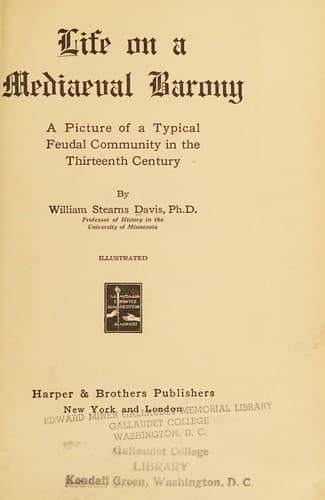
Life on a Mediaeval Barony: A Picture of a Typical Feudal Community in the Thirteenth CenturyDavis, William Stearns
History
Life on a Mediaeval Barony: A Picture of a Typical Feudal Community in the Thirteenth Century
Davis, William Stearns
Chivalry; Civilization, Medieval; Feudalism
You can go on multiplying stories about famines--how human flesh at
times was sold in markets; how starving children were lured by the
offers of a bit of food to places where ghouls could kill and feast on
them; how a measure of corn rose to sixty sous in gold; and how even
the very rich "lost their color." These days, thanks be to the saints,
seem disappearing; yet the danger of pinching hard times is still a
real one, even in fortunate St. Aliquis.[78]
The peasants of Messire Conon are free. The serfs of the barony had
been manumitted about a hundred years earlier, by a baron who (after
an extremely iniquitous life) was admonished on his deathbed by his
confessor that he must do something extraordinary for the salvation of
his soul.[79] As a result the St. Aliquis peasants were no longer bound
to the soil and could quit the seigneury--as serfs assuredly could not
do. They could also marry any women they wished without asking their
lord's consent or paying him a fee. They could bequeath their goods
without having him sequester an outrageous part. All this, of course,
improved their status, yet they were still subject to numerous imposts
in money and kind, and to various forms of forced labor. Although they
had now the legal right to quit the barony, only with the greatest
difficulty could they sell their little farms and chattels thereon, so
they could take a decent share of their possessions elsewhere; and if
they wandered to distant parts, the local authorities were likely to
call them "masterless men" and assume that if they had forsaken their
old lord they must somehow be criminals.
[Sidenote: Exploitation of Villeins]
Nevertheless, it is much better to be a free peasant than a serf. The
majority of the French lower classes are now becoming free, although
in other Christian lands, notably Germany, serfage will prevail for a
weary day hereafter.
But even though one becomes free, he is a villein still. The taint
of ignoble blood clings like a shirt of pitch, even after achieving
prosperity and wealth. Knightly opinion is expressed by that great
troubadour, Bertran de Born: "I love to see the rich churl in distress
if he dares to strive with nobles. I love to see him beg his bread in
nakedness."
Even a well-disposed lord looks on a peasant largely as a source of
income. In time of peace the taxes and forced labor squeezed out of
him yield that which presently turns into destrers, silvered hauberks,
furs, hawks, fair dames' luxuries, dowries, adubbements, tourneys.
In time of war he exists to be pillaged and massacred, in order to
impoverish his master by ruining the latter's revenues. The burghers of
the towns are a little more respected. Their industrial products are
needful. They can better protect themselves. But the richest syndic of
a commune cannot really hold up his head socially with the unknighted
bachelor who drags out life in a tumble-down manor house.
Public-domain text, read in full here on John Shaqi.
Reviews
Reviews
No reviews yet
Be the first to share your thoughts on this work.
Elsewhere in the archive
Join the Discussion
Join the discussion
Sign in to leave a comment or review.
Sign InorCreate an account