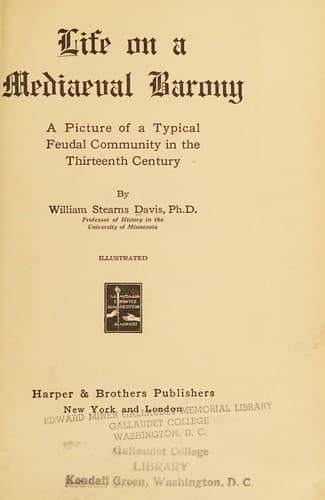
Life on a Mediaeval Barony: A Picture of a Typical Feudal Community in the Thirteenth CenturyDavis, William Stearns
History
Life on a Mediaeval Barony: A Picture of a Typical Feudal Community in the Thirteenth Century
Davis, William Stearns
Chivalry; Civilization, Medieval; Feudalism
Leprosy is a terrible scourge. Its nature is misunderstood. Often
severe but curable cases of eczema are confounded therewith, and
harmless victims are condemned to a death in life--perpetual banishment
to filthy cabins in the woods. Cholera and smallpox every now and
then break out in a neighborhood, and they are almost always fatal.
Nothing really can be done to check them except to pray to the saints.
Such diseases are (say the best informed) communicated "in the air";
consequently any ordinary isolation is useless. On the whole, they
ravage the villages more than they do the castles, though hardly
because the castle folk are able to take more effective physic. Yet
often enough a baron and his entire family may be swept away. Very
seldom is it suggested that pure water, cleanliness, and rational
schemes of isolation can accomplish much to defeat the apparent desire
of heaven to devastate an entire duchy.
Other diseases are fearfully common. The sufferers from nervous
complaints make up small armies. The general terrors and wars of the
times, the brooding fears of the devil, hell, and the eternal torment,
the spectacle of the fearful punishments, and, on the other hand, the
sheer ennui of life in many castles and in certain ill-ruled convents,
drive men and women out of their wits. Such sufferers are lucky if they
are treated with kindness and are not, as being "possessed of devils,"
clapped in a dungeon.
Finally, it should be said that lucky is the mother who does not have
one-third to one-half of all her offspring die in the act of birth.
Every entrance of a babe into the world is a dice throwing with death,
even if the mid-wife is clever. Once born, the children are likely to
be so injured in the initiatory process that they will be physically
imperfect or dangerously weakened. This is true even in the royal
families; how much more true in the peasant huts! It is not surprising
that the average man of the Feudal Ages can give and sustain hard
blows. Only the strongest have been able to survive the ordeals of
birth and childhood.
To fight these dangers, one must invoke both human and divine aid.
Good Christians usually feel that the healing saints avail more than
do physicians or wise women. If you have indigestion, invoke St.
Christopher; if dropsy, St. Eutropius; if fever, St. Petronila; for
the pest, St. Roch; for insanity, St. Mathurin; for kidney complaint,
St. René; for cramps, St. Crampan--and so with many other ills.
Nevertheless, one need not trust solely to prayers. Only great people,
however, employ regular physicians (_mires_). Villeins commonly have
in a "good woman," much better than a sorcerer. The breath of an ass
drives poison from a body. The touch of a dead man's tooth cures
toothache. If you have a nosebleed, seize the nose with two straws
shaped like a cross. If the itch troubles you, roll yourself naked in a
field of oats. Georges, the peasant, will tell you that such remedies
seldom fail.
Public-domain text, read in full here on John Shaqi.
Reviews
Reviews
No reviews yet
Be the first to share your thoughts on this work.
Elsewhere in the archive
Join the Discussion
Join the discussion
Sign in to leave a comment or review.
Sign InorCreate an account