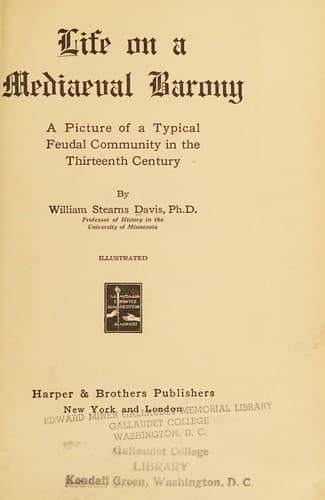
Life on a Mediaeval Barony: A Picture of a Typical Feudal Community in the Thirteenth CenturyDavis, William Stearns
History
Life on a Mediaeval Barony: A Picture of a Typical Feudal Community in the Thirteenth Century
Davis, William Stearns
Chivalry; Civilization, Medieval; Feudalism
Besides the study of these older books, the monks are writing certain
books themselves. The most important is the great chronicle, begun some
years ago by the learned Brother Emeri. It commences with the creation
of the world and Adam and Eve, tells about the Greeks and Romans and
Charlemagne and his heirs, and then in much greater detail gives the
recent history of the Duchy of Quelqueparte, the happenings at the
abbey, and also much about the barons of St. Aliquis. Emeri is now
dead, but the chronicle is continued from year to year. It is really
a compendium of varied learning. From it, for example, you learn all
about the wars of Julius Cæsar, the Crusades, the great lawsuit of ten
years ago over some of the abbey lands, the feud between Conon and
Foretvert, and how in 1216 a two-headed calf was born on a neighboring
barony, and in 1217 a meteor struck near Pontdebois.
The Latin in this chronicle is, on the whole, very good, sometimes
almost equal to Livy's, and the story is embellished by constant
citations not merely of Virgil and Horace, but of Homer and Plato. One
would suppose from this that the authors were familiar with Greek.
Such, however, is by no means the case. All the quotations from Greek
authors and many of their Latin ones are taken from commonplace books.
Nevertheless, the narrative seems the more elegant for this borrowed
learning. The monks are proud of their chronicle and never fail to
boast how much more complete, accurate, and erudite it is than similar
works compiled at the rival institutions.
When the monks are not actually studying, they are often copying. St.
Aliquis has more than two hundred volumes in its library. Parchment
is very expensive, but very durable. When the abbot sees his way to
procure material for another volume, he is likely to send to some
friendly convent to borrow a book which his monks do not yet possess.
Then some of the most skillful brethren are put to work making a copy,
if possible more beautiful than the original. In from six months to a
year the work will probably be finished, although, if a duplicate is
to be made of a work already on hand, there will be less haste and the
process may extend over years.[100]
Copying is an excellent means of propitiating Heaven. St. Bernard said
emphatically, "Every word which you write is a blow which smites the
devil," and Cassiodorus, much earlier, asserted: "By the exercise of
the mind upon the Holy Scriptures you convey to those who read a kind
of moral instruction. You preach with the hand, converting the hand
into an organ of speech--thus, as it were, fighting the arch-fiend with
pen and ink."
Public-domain text, read in full here on John Shaqi.
Reviews
Reviews
No reviews yet
Be the first to share your thoughts on this work.
Elsewhere in the archive
Join the Discussion
Join the discussion
Sign in to leave a comment or review.
Sign InorCreate an account