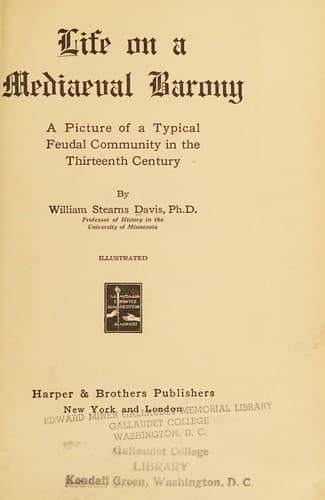
Life on a Mediaeval Barony: A Picture of a Typical Feudal Community in the Thirteenth CenturyDavis, William Stearns
History
Life on a Mediaeval Barony: A Picture of a Typical Feudal Community in the Thirteenth Century
Davis, William Stearns
Chivalry; Civilization, Medieval; Feudalism
As for the more abstract sciences, in music the monks know the four
principal and the four secondary sounds--the _do_, _re_, _mi_, of the
scales, the seven modulations and the five strings of the viol. In
geometry they can, with the aid of a stick, "lying on the ground find
the height of walls and towers." In arithmetic they can multiply and
divide with great facility and keep accounts like a king's treasurer.
In astronomy they understand the motion of the planets and their
qualities--Saturn, which is "proud, wise, and ambitious," and Mars,
"malevolent and bad, provoking strife and battles," and how the sun is
hung in the midst of the planets, three above and three below, and much
more similar wisdom; although one must proceed carefully in astronomy,
for its connection with astrology is close, and from astrology to the
black art is not a long journey.
[Sidenote: Scientific Studies and Chronicle Writing]
The good monks have perhaps made their best progress in botany and
geology. Some of the brethren have gathered collections of curious
minerals, of herbs, and also of dried bird and animal skins; although
the interest seems to be in the healing qualities of various substances
rather than in the nature of the things themselves. Thus it is certain
that figs are good for wounds and broken bones; aloes stops hair from
falling; the root of mandrake will make women love you; and plenty of
sage in a garden somehow protects the owner from premature death. As
for geology, that consists of the collecting and arranging of curious
stones. It is of course settled in Genesis that the world was made in
a very few days. The infidel Avincenna has indeed advanced the theory
that mountains are caused by the upheaval of the earth's crust and by
action of water. One must hesitate, however, about believing this. It
seems hardly compatible with Holy Writ.
On the other hand, the books on animals unhesitatingly tell about
remarkable creatures which are mentioned in Aristotle or in Pliny or
by the Arabs. Unicorns, phoenixes, and dragons are well understood,
likewise sea monsters, as, for example, great krakens, which drag
down ships with their tentacles, sirens or mermaids, and finally "sea
bishops" (probably a kind of seal) which piously "bless" their human
victims before devouring them.
Public-domain text, read in full here on John Shaqi.
Reviews
Reviews
No reviews yet
Be the first to share your thoughts on this work.
Elsewhere in the archive
Join the Discussion
Join the discussion
Sign in to leave a comment or review.
Sign InorCreate an account