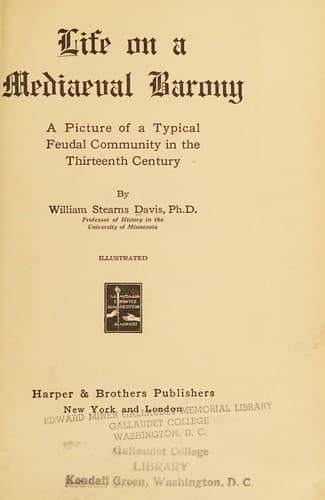
Life on a Mediaeval Barony: A Picture of a Typical Feudal Community in the Thirteenth CenturyDavis, William Stearns
History
Life on a Mediaeval Barony: A Picture of a Typical Feudal Community in the Thirteenth Century
Davis, William Stearns
Chivalry; Civilization, Medieval; Feudalism
The roads are no worse than elsewhere, yet they are abominable; trails
and muddy ruts they seem most of the year, ordinarily passable only
for horses and mules, although in the summer rude two-wheeled carts
can bump along them. To cross the streams you must, in some places,
depend on fords very dangerous in the springtime. One unfordable
river, entering the Claire, is indeed crossed by a rude wooden
bridge. The building of bridges is fostered by the Church. A great
indulgence was proclaimed by the bishop some years ago when this bridge
was constructed as a pious work, especially useful for pilgrims.
Unfortunately, no one is responsible for its upkeep. It is falling
into disrepair, and already is so tottering that as men pass over it
they repeat those formulas, "commending their souls to God," which the
Church provides for use whenever one is attempting unstable bridges.
[Sidenote: Travelers and Inns]
On the journey you meet many humble travelers obliged to trudge
weary miles. There is a poor peasant seeking a farm now on a distant
seigneury. He has a donkey to carry some of his household gear and one
of the children. His wife is painfully carrying the youngest infant.
The poor man himself staggers under a great sack. Travelers of more
consequence ride horseback, with a large mail or leathern portmanteau
tied on their beast's crupper. Their burdens are heavy because one
often has to spend the night in abominable quarters, and consequently
must, if possible, carry flint, steel, and tinder for making a fire,
some kind of bedding, and very often a tent. Along the road, too, are
any quantity of beggars, real or pretended cripples and other deformed
persons, wandering about and living on charity; or blind men with
staffs and dogs. The beggars' disguise is a favorite one for robbers.
The wretches, too, who whine their, "Alms, Messire! Alms!" and hold
up a wrist minus the hand, or point to where an eye has been gouged
out, probably have suffered just punishments for crimes, although some
of them may have mutilated themselves merely in order to work on the
sympathies of the gullible.
Public-domain text, read in full here on John Shaqi.
Reviews
Reviews
No reviews yet
Be the first to share your thoughts on this work.
Elsewhere in the archive
Join the Discussion
Join the discussion
Sign in to leave a comment or review.
Sign InorCreate an account