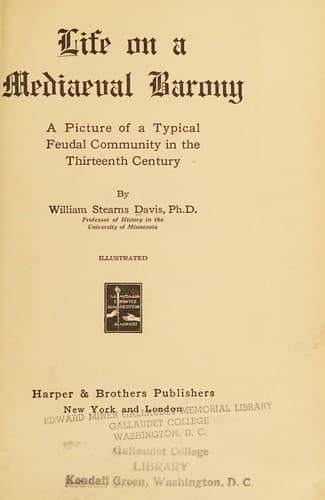
Life on a Mediaeval Barony: A Picture of a Typical Feudal Community in the Thirteenth CenturyDavis, William Stearns
History
Life on a Mediaeval Barony: A Picture of a Typical Feudal Community in the Thirteenth Century
Davis, William Stearns
Chivalry; Civilization, Medieval; Feudalism
As a rule the goods are made up in the rear of the shop and are sold
over a small counter directly upon the street, where the customer
stands while he drives his bargain. Written signs and price cards
are practically unknown. The moment a possible purchaser comes in
sight, all the attendants near the front of the shops begin a terrific
uproar, each trying to bawl down his neighbor, praising his own wares
and almost dragging in the visitor to inspect them. Trade etiquette
permits shopkeepers to shout out the most derogatory things about
their rivals. Father Grégoire, wishing to buy some shoes, is almost
demoralized by the clamor, although this is by no means his first visit
to Pontdebois. As he enters the Shoemakers' Lane it seems as if all the
ill-favored apprentices are crowding around him. One plucks his cape.
"Here, good Father! Exactly what you want!" "Hearken not to the thief,"
shouts another; "try on our shoes and name your own price!" A third
tries to push him into yet another stall. "Good sirs," cries Grégoire,
in dismay, "for God's sake treat me gently or I'll buy no shoes at
all!" Only reluctantly do they let him make his choice, then conclude a
bargain unmolested by outsiders. In the fish, bread, and wine markets
the scenes can be even more riotous, while the phrases used by the
hucksters in crying their wares are peculiar and picturesque.
As always in trade, it is well that "the buyer should beware"; fixed
prices are really unknown and inferior goods are inordinately praised.
Nevertheless, the city and guild authorities try hard to protect
purchasers from misrepresentation. The officers are always making
unannounced rounds of inspection to see how the guild ordinances are
being obeyed.[111] The fate of the rascally woolen maker has been
noted. Heavy fines have also been imposed lately upon a rope maker who
put linen in a hemp cord, and a cutler who put silver ornaments in a
bone knife handle. This, however, was not to protect purchasers, but
because they had gone outside the line of work permitted to members of
their guild and trenched upon another set of craftsmen. Indeed, a very
short residence in Pontdebois makes one aware that within the chartered
commune the question is not, as in strictly feudal dominions, "Whose
'man' is he?" but "To what guild does he belong?" Everything apparently
revolves around the trade and craft guilds.
Public-domain text, read in full here on John Shaqi.
Reviews
Reviews
No reviews yet
Be the first to share your thoughts on this work.
Elsewhere in the archive
Join the Discussion
Join the discussion
Sign in to leave a comment or review.
Sign InorCreate an account