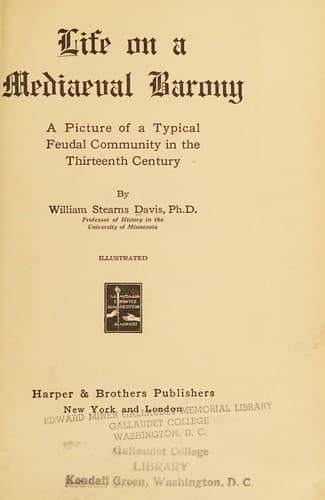
Life on a Mediaeval Barony: A Picture of a Typical Feudal Community in the Thirteenth CenturyDavis, William Stearns
History
Life on a Mediaeval Barony: A Picture of a Typical Feudal Community in the Thirteenth Century
Davis, William Stearns
Chivalry; Civilization, Medieval; Feudalism
Some of these guilds, like that of the butchers, are alleged to be much
older than the granting of the charter; but it is undeniable that the
organizations have multiplied and grown in power since that precious
document was obtained.[112] Each special industry goes to the seigneur
(in this city to the bishop) for a special grant of privileges and
for a fee he will usually satisfy the petitioners, especially as they
desire the privileges mainly to protect them against their fellow
craftsmen, not against himself. In Paris there are more than three
hundred and fifty separate professions; in Pontdebois they are much
fewer, yet the number seems high. Many guilds have only a few members
apiece, but even the smallest is mortally jealous of its prerogatives.
One "mystery" makes men's shoes, another women's, another children's.
Some time ago the last mentioned sold some alleged "children's shoes"
which seemed very large! Result--a bitter law suit brought by the
women's shoemakers. Christian charity among the guildsmen has not been
restored yet. In Paris they say that the tailors are pushing a case
against the old-clothes dealers because the latter "repair their
garments so completely as to make them practically new." There will
soon be handsome fees for the kings' judges, if for nobody else.[113]
[Sidenote: Division and Regulations of Guilds]
Such friction arises, of course, because each guild is granted a strict
monopoly of trade within certain prescribed limits. A saddle maker from
a strange city who started a shop without being admitted to the proper
guild would soon find his shop closed, his products burned, and his
own feet in the stocks by the town donjon. The guilds are supposed to
be under strict regulations, however, in return for these privileges.
Their conditions of labor are laid down, as are the hours and days of
working. The precise quality of their products is fixed, and sometimes
even the size of the articles and the selling price. Night work, as
a rule, is forbidden, because one cannot then see to produce perfect
goods, although carpenters are allowed to make coffins after sunset.
On days before festivals everyone must close by 3 P.M., and on feast
days only pastry shops (selling cakes and sweetmeats) are allowed to be
open. Violaters are subject to a fine, which goes partly to the guild
corporation, partly to the town treasury; and these fines form a good
part of the municipal revenue.
Public-domain text, read in full here on John Shaqi.
Reviews
Reviews
No reviews yet
Be the first to share your thoughts on this work.
Elsewhere in the archive
Join the Discussion
Join the discussion
Sign in to leave a comment or review.
Sign InorCreate an account