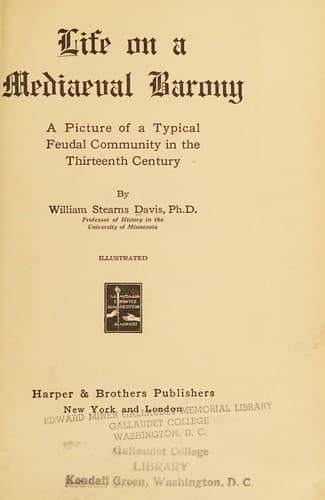
Life on a Mediaeval Barony: A Picture of a Typical Feudal Community in the Thirteenth CenturyDavis, William Stearns
History
Life on a Mediaeval Barony: A Picture of a Typical Feudal Community in the Thirteenth Century
Davis, William Stearns
Chivalry; Civilization, Medieval; Feudalism
The guilds are not labor unions. The controlling members are all
masters--the employers of labor, although usually doing business
on a very small scale. A guild is also a religious and benevolent
institution. Every corporation has its patron saint, with a special
chapel in some church where a priest is engaged to say masses for the
souls of deceased members.[114] If a member falls into misfortune
his guild is expected to succor him and especially, if he dies, to
look after his widow and assist his orphans to learn their father's
craft. Each organization also has its own banner, very splendid, hung
ordinarily beside the guild's altar, but in the civic processions
proudly carried by one of the syndics, the craft's officers. To be a
syndic in an influential guild is the ordinary ambition of about every
young industrialist. It means the acme of power and dignity attainable,
short of being elected echevin.
The road to full guild membership is a fairly difficult one, yet it
can be traversed by lads of good morals and legitimate birth if they
have application and intelligence. A master can have from one to three
apprentices and also his own son, if he has one who desires to learn
the trade. The apprentices serve from three to twelve years.
[Illustration: A COMMONER (THIRTEENTH CENTURY)
From a bas-relief in the cathedral of Rheims.]
[Sidenote: Apprentices, Hired Workers and Masters]
The more difficult the craft the longer the service; thus it takes a
ten-year apprenticeship to become a qualified jeweler. The lads thus
"bound out" cannot ordinarily quit their master under any circumstances
before the proper time. If they run away they can be haled back and
roundly punished. They are usually knocked about plentifully, are none
too well clothed, sleep in cold garrets, are fed on the leavings from
the master's table, and can seldom call a moment their own except on
holidays. Their master may give them a little pocket money, but no
regular wages. On the other hand, he is bound to teach them his trade
and to protect them against evil influences. Often enough, of course,
matters end by the favorite apprentice marrying his master's daughter
and practically taking over the establishment.
Public-domain text, read in full here on John Shaqi.
Reviews
Reviews
No reviews yet
Be the first to share your thoughts on this work.
Elsewhere in the archive
Join the Discussion
Join the discussion
Sign in to leave a comment or review.
Sign InorCreate an account