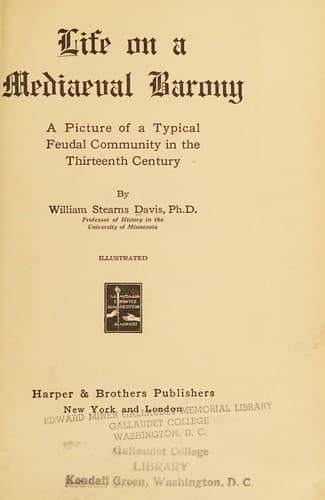
Life on a Mediaeval Barony: A Picture of a Typical Feudal Community in the Thirteenth CenturyDavis, William Stearns
History
Life on a Mediaeval Barony: A Picture of a Typical Feudal Community in the Thirteenth Century
Davis, William Stearns
Chivalry; Civilization, Medieval; Feudalism
It is alleged that from these lower vaults there is an underground
passage leading from the castle to a secret sallyport at the foot
of the precipice by the Rapide. If a passage exists, however, it is
known only to Conon and a very few trusted retainers. But not all such
stories are false; many castles have such secret passages; and at Coucy
they are quietly planning to introduce a rather elaborate system of the
same. Quite possibly St. Aliquis possesses something of this nature.
Far pleasanter is it now to ascend from the main hall through a couple
of stages of upper and airier chambers (now used as apartments by part
of the castle folk) until by a dizzy ladder we reach the summit of the
donjon itself. Here on one edge of the broad platform is a little round
turret carrying us still higher. From the turret flutters the orange
banner of St. Aliquis, with some kind of a black dragon (in memory,
possibly, of the viking raid) broidered upon it, and the arrogant
legend of the noble family, "Rather break than bend." To lower this
banner were a horrid disgrace. Never is it to be struck unless the
castle surrenders, when it will be sadly flung into the moat.
Under the flagstaff is a stout projecting beam rigged with a pulley.
Here is a gibbet in case the baron wishes to hang offenders as a
warning for the countryside. Fortunately, however, Adela has a dislike
to seeing the corpses dangling, and has persuaded Conon to order his
recent hangings at the ordinary gallows across the Claire by the
village. On the flag turret is always a watchman; day or night some
peasant must take his turn, and even in peace he has no sinecure. He
must blow on his great horn at sunrise, at "cover fire" at night,
when the baron's hunt rides out and returns, and again when a strange
retinue approaches the gate. The whole wide countryside spreads in a
delightful panorama below him at present, but on winter nights, when
every blast is howling around the donjon, the task is less grateful. No
wonder that peasants impressed for this service complain that "watchmen
have the lot of the damned."
So back through the donjon and again to the castle court. The donjon is
purely military. In times of peace it is a mere storehouse, prison, and
supplementary barrack for the seigneur's people. In war it is the last
position where the garrison can stand desperately at bay. A hundred
years earlier Adela and her sister-in-law, Alienor, would have lived
out most of their days in the cheerless dark chambers directly above
the main hall. Now they are more fortunate. They dwell in the elegant
Gothic arched _palais_.
[Sidenote: Great Hall of the Palais]
Public-domain text, read in full here on John Shaqi.
Reviews
Reviews
No reviews yet
Be the first to share your thoughts on this work.
Join the Discussion
Join the discussion
Sign in to leave a comment or review.
Sign InorCreate an account