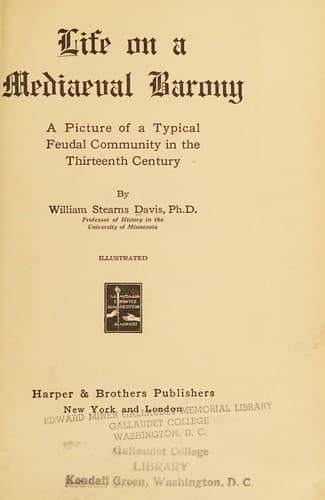
Life on a Mediaeval Barony: A Picture of a Typical Feudal Community in the Thirteenth CenturyDavis, William Stearns
History
Life on a Mediaeval Barony: A Picture of a Typical Feudal Community in the Thirteenth Century
Davis, William Stearns
Chivalry; Civilization, Medieval; Feudalism
All this is undeniable. Yet it must be remembered that the number
of parish clergy is very great, and the proportion of evildoers is
(considering their manner of appointment) no more than might be
expected. Many of the parish priests are true ministers of God who
counsel the simple, persuade the erring, comfort the sorrowing, and
leave the world better than they found it. A few, too, spend their
leisure in genuine pursuit of learning, like that Father Lambert
of Ardes (in Flanders) who is deeply read in old Latin authors
and Christian fathers and who has composed an excellent local
chronicle--worthy to rank with the best produced in the monasteries.
Taken, therefore, at large, despite much dross, the men of the Church
do not cast away their great opportunity. If alms and charity relieve
the wretched, if letters and science have a genuine power, if the world
retains other ideals than those of the tourney, the feud, and the
foray, if villeins are taught that they, too, are men with immortal
souls no less than are the barons, the glory belongs surely not to
the castle, but to the monastery and to the parish. And when a good
churchman dies, especially, of course, if he has been an effective and
benignant bishop, all the region knows its loss. When the late Bishop
of Auxerre departed, it was written, "It would be impossible to tell
how great was the mourning throughout the entire city, and with what
groaning and lamentations sorrow was shown by all who followed his
funeral." While of the great and good Bishop Maurice of Paris, builder
of Notre Dame, it was recorded, when he passed in 1196, that "he was
a vessel of affluence, a fertile olive tree in the house of the Lord.
He shone by his knowledge, his preaching, his many alms, and his good
deeds."
Like every other institution, the Church of the Feudal Age is entitled
to be judged by its best and not by its worst.
FOOTNOTES:
[120] _One third_ of the real estate of Germany was alleged to
have belonged to the church. Of course, much of this belonged to
monasteries, to the endowments of canons (cathedral clergy), or of the
parish priests, etc., but the bishops assuredly enjoyed or at least
controlled the lion's share.
[121] In the case of heretics, the Church did not execute the offenders
by its own officers. It merely "relaxed" them to secular officials,
who at once put the old civil laws against misbelievers in force. Of
course, the Church could not secure the immunity of traitors and great
criminals, yet even those were usually treated more tenderly if they
could claim ecclesiastical jurisdiction.
[122] One could go on multiplying such cases. For example, Maurice of
Sully, who was bishop of Paris under Philip Augustus, was the son of
a poor peasant. He managed his diocese admirably and bequeathed not
merely considerable wealth to his relatives, but large properties to
two abbeys and also funds for poor relief.
Public-domain text, read in full here on John Shaqi.
Reviews
Reviews
No reviews yet
Be the first to share your thoughts on this work.
Elsewhere in the archive
Join the Discussion
Join the discussion
Sign in to leave a comment or review.
Sign InorCreate an account