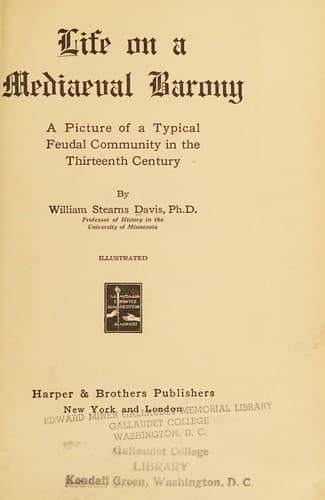
Life on a Mediaeval Barony: A Picture of a Typical Feudal Community in the Thirteenth Century — John Shaqi
Life on a Mediaeval Barony: A Picture of a Typical Feudal Community in the Thirteenth CenturyDavis, William Stearns
History
Life on a Mediaeval Barony: A Picture of a Typical Feudal Community in the Thirteenth Century
Davis, William Stearns
Chivalry; Civilization, Medieval; Feudalism
This book describes the life of the Feudal Ages in terms of the
concrete. The discussions center around a certain seigneury of St.
Aliquis. If no such barony is easily identifiable, at least there were
several hundred second-grade fiefs scattered over western Christendom
which were in essential particulars extremely like it, and its Baron
Conon and his associates were typical of many similar individuals, a
little worse or a little better, who abounded in the days of Philip
Augustus.
No custom is described which does not seem fairly characteristic of
the general period. To focus the picture a specific region, northern
France, and a specific year, A.D. 1220, have been selected. Not many
matters have been mentioned, however, which were not more or less
common to contemporaneous England and Germany; nor have many usages
been explained which would not frequently have been found as early as
A.D. 1100 or as late as 1300.
Northern France was _par excellence_ the homeland of Feudalism and
hardly less so of Chivalry, while by general consent the years around
1220 mark one of the great turning epochs of the Middle Ages. We are at
the time of the development of French kingship under Philip Augustus,
of the climax and the beginning of the waning of the crusading spirit,
of the highest development of Gothic architecture, of the full
blossoming of the popular Romance literature, and of the beginning of
the entirely dissimilar, but even more important, Friar movement.
To make the life of the Middle Ages live again in its pageantry and
its squalor, its superstition and its triumph of Christian art and
love, is the object of this study. Many times has the author been
reminded of the _intense contrasts_ between sublime good and extreme
evil everywhere apparent in the Feudal Epoch. With every effort at
impartiality, whether praising or condemning, it is dangerously easy to
write in superlatives.
Although the preparation of this book was not undertaken without that
knowledge and investigation of those mediæval authors, ecclesiastics,
and laymen upon which every significant study of this kind must
rest, every scholar will recognize the author's debt to many modern
specialists. To Th. Wright, Lacroix, Luchaire, Justin H. Smith,
Viollet-le-Duc, and Chéruel the acknowledgments are very specific. To
Leon Gautier they must be more specific still. It is a great misfortune
that his masterpiece, _Le Chivalrie_, is no longer current in a good
English translation. The words in quotation, sprinkled through the
text, are usually from pertinent mediæval writers, except where they
purport to be direct snatches of conversation.
To my colleague in this university, Prof. August C. Krey, who has read
and criticized the manuscript with friendly fidelity and professional
alertness and acumen, there are due many hearty thanks.
W. S. D.
The University of Minnesota.
Minneapolis, Minn.
Life on a
Mediaeval Barony
[Illustration]
Public-domain text, read in full here on John Shaqi.
Reviews
Reviews
No reviews yet
Be the first to share your thoughts on this work.
Join the Discussion
Join the discussion
Sign in to leave a comment or review.
Sign InorCreate an account