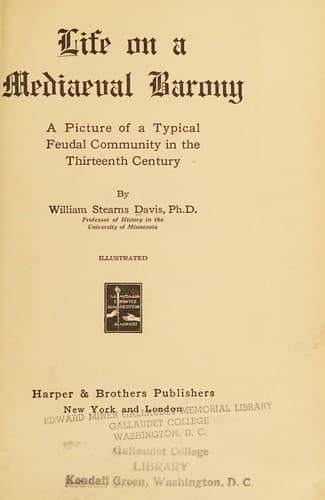
Life on a Mediaeval Barony: A Picture of a Typical Feudal Community in the Thirteenth CenturyDavis, William Stearns
History
Life on a Mediaeval Barony: A Picture of a Typical Feudal Community in the Thirteenth Century
Davis, William Stearns
Chivalry; Civilization, Medieval; Feudalism
We have said that Conon is resolved to knight his brother at the same
time he gives his sister in marriage. This involves holding a tourney
and many other proceedings really unnecessary for a wedding; but, of
course, it will attract a much greater number of guests and advertise
the prosperity of the baron of St. Aliquis to all northwestern France.
The knighting and tourney will come after the bridal, however, and it
is easier to explain the two things separately. We omit the gathering
of the wedding guests--the coming of distant counts, barons, and sires;
the erection around St. Aliquis of a real village of brilliant tents
and pavilions; the ceremonious greetings; the frenzied efforts of the
castle folk to make all ready; the inevitable despair, not once, but
many times, of Adela, who directs everything. At last it is the morning
of _the_ day, in midsummer. No rain and, blessed be St. Martin, not
too much heat. Alienor is surrounded by a dozen women, old and young,
arraying her for her wedding.
[Sidenote: Dressing the Bride]
There is no regular bridal costume. Alienor does not dress much
differently from what she does on Easter or at some other major
festival. Her two great braids of hair are weighted down over her
breasts with an extra intertwining with gold thread. Her chemise is
of very fine saffron-tinted linen. Her pelisson is completely fringed
with magnificent ermine, the gift of the Countess of Perseigne, and
the garment itself is made of two cloths sewed together, the inner of
fine wool, the outer of beautiful bendal of reddish violet. The whole
is laced tightly until Alienor can hardly breathe. Above this garment
floats the elegant bliaut, of green silk with long sleeves, many
folds, and a long train. There is more silk embroidery and elaborate
flouncing. Fairest of all is the girdle, made of many pieces of gold
and each set with a good-luck stone--agate to guard against fever,
sardonyx to protect against malaria, and many similar. In the clasp
are great sapphires which Baron Garnier originally "acquired" from
a town merchant shortly before he hanged him. Finally, there is the
mantle--again of silk intricately embroidered and dyed with a royal
purple.
Alienor's pointed shoes are of vermilion leather from Cordova, with
still more of gold-thread embroidery. While one female minister is
clasping these, her chief pucelle is putting on a small saffron-colored
veil, circular, and held down by a golden circlet--a genuine crown;
beautifully engraved and set with emeralds. Inevitably the whole
process of dressing is prolonged. Alienor is too excited to feel hot
or pinched, but her attendants find her very exacting. They bless the
Virgin, however, that she is not as some noble brides, who fly into a
passion if every hair in their eyebrows is not separately adjusted.
Public-domain text, read in full here on John Shaqi.
Reviews
Reviews
No reviews yet
Be the first to share your thoughts on this work.
Elsewhere in the archive
Join the Discussion
Join the discussion
Sign in to leave a comment or review.
Sign InorCreate an account