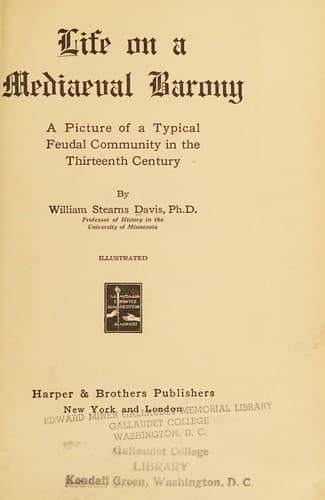
Life on a Mediaeval Barony: A Picture of a Typical Feudal Community in the Thirteenth CenturyDavis, William Stearns
History
Life on a Mediaeval Barony: A Picture of a Typical Feudal Community in the Thirteenth Century
Davis, William Stearns
Chivalry; Civilization, Medieval; Feudalism
As for eggs and butter, they are gifts of the kindly saints, to carry
men through Lent and fast days. Theologians have said that hens were
aquatic creatures, like other birds; that hence good Christians could
eat their eggs freely. But butter (by some unaccountable notion) if
eaten during times of abstinence, must be freshly churned. It must not
be salted, nor used for cooking purposes.
Passing next to beverages, be it said that the St. Aliquis denizens are
fairly abstemious folk. All of them sometimes get tipsy, even Adela
and Alienor, but only seldom. Conon's servants help him to bed once or
twice per year. Down in the villages there are disgraceful guzzlings
among the peasants, especially on saints' days. But the beverages are
not very alcoholic--one must absorb a great deal to be really upset.
The region grows its own wine for ordinary consumption, and a little
thereof is shipped to Paris and even to Flanders and England, along
with the more famous vintages of Gascony, Saintonge, Macon, Rheims,
the Marne, and the Orleanais. The most desirable French wine is that
of St. Pourcain, in Auvergne, and the baron has a carefully cherished
tun of the same in his cellars. Poems, indeed, exist in praise of this
St. Pourcain wine, "which you drink for the good of your health." On
occasions of great state, however, imported wines will be produced,
mainly because they are unusual and expensive. The St. Aliquis feasters
are consequently offered heady Cyprian and Lesbian from the Levant,
also Aquilian from Spain, and not a little Rhenish from the German
lands, less distant.
[Sidenote: Wine, Beer and Other Drinks]
In the autumn when the apples and pears are falling, the peasants will
make cider and perry, and get outrageously drunk when these beverages
grow hard; but outside of Normandy such drink seldom appeals to castle
folk. There are also in common use many substitute wines, really
infusions of wormwood, hyssop, and rosemary, and taken mostly to clear
the system; although "nectar" made of spices, Asiatic aromatics, and
honey is really in request.
The great competitor of wine is beer. In northern France we are in the
dividing zone between the land of the winepress and the land of the
brewhouse. Everybody drinks beer and makes beer. The castle has a great
brewhouse; likewise the monastery. Beer is made of barley, and only
late in the Middle Ages will hops be added to add to the zest. Really
fine beer is _god-ale_ (from the German "good" and "ale") or "double
beer." Common beer is "small beer." Since the Crusaders have returned
from the East, spiced beer has been growing in favor--charged with
juniper, resin, gentian, cinnamon, and the like, until the original
taste has been wholly destroyed.
The St. Aliquis folk do not, however disdain buttermilk. This they
like to ferment, boil up with onions and garlic, then cool in a closed
vessel. The product is _serat_, the enjoyment of which is surely
difficult for a stranger.
Public-domain text, read in full here on John Shaqi.
Reviews
Reviews
No reviews yet
Be the first to share your thoughts on this work.
Elsewhere in the archive
Join the Discussion
Join the discussion
Sign in to leave a comment or review.
Sign InorCreate an account