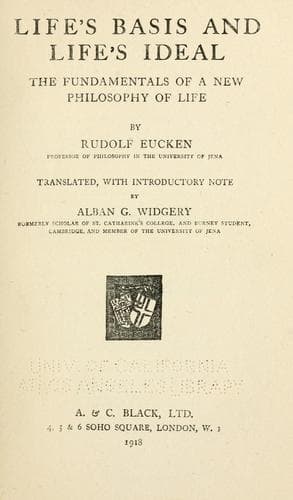
Life's Basis and Life's Ideal: The Fundamentals of a New Philosophy of LifeEucken, Rudolf
Philosophy
Life's Basis and Life's Ideal: The Fundamentals of a New Philosophy of Life
Eucken, Rudolf
Life; Ontology
Again, the great force that has been exerted in the movement of history
in the detection and the elimination of contradictions can be explained
only in this context. Logic, as we saw, played an unassuming rôle in
this matter, and the indolence of man always inclined to easy
accommodation and compromise. It was the increased vital energy, the
adoption of a particular issue as the main issue, that made movements,
which had long existed in a state of harmony and peace, irreconcilable
enemies, and drove them to a life-and-death struggle. With a lower level
of spiritual activity the Middle Ages unsuspiciously united a religion
of ecclesiastical organisation with a religion of personal feeling and
disposition; and it did not feel that there was an inconsistency in
their union so much as that one was the completion of the other. As soon
and so far, however, as in the Modern Age spirituality won more
independence and more self-consciousness, and felt itself to be the
centre of the whole, it was inevitable that a dependence upon an
external order should be experienced only as an intolerable oppression;
and the division of life between the one and the other became an
impossibility. It was necessary only that a powerful and passionate
personality, like that of Luther, should take up the problem, and make
it the sole object of his effort, and the hour of revolution had come.
How meanly they think of the controlling forces of history who would
trace back such changes to the selfishness or the vanity of individuals!
Looked at from our point of view, the inner changes within the life of
universal history often appear to be simplifications--cases of energetic
concentration on the essential, and of fundamental separation of the
subsidiary. The truly great carry on a ceaseless conflict against the
chaotic confusion which the life of the majority is wont to produce ever
anew--a condition in which matters of the first importance are confused
with those that are subsidiary; all inner gradation is lacking; and the
great is treated as something insignificant, and the insignificant as
something great. There is a struggle to secure a clear differentiation
and gradation; to establish a centre, and to transform life into a
genuinely self-conscious life. Have not all the principal revivals of
religion, of morality, of education, been simplifications?
Public-domain text, read in full here on John Shaqi.
Reviews
Reviews
No reviews yet
Be the first to share your thoughts on this work.
Elsewhere in the archive
Join the Discussion
Join the discussion
Sign in to leave a comment or review.
Sign InorCreate an account